Wednesday, March 31, 2010

Top ten LA noir novels

Jonathan Kellerman is the author of the Alex Delaware novels. He named a top ten list of LA noir novels for the Guardian.

Two books on his list:
The Black Dahlia and The Big Nowhere by James Ellroy

Thirty years on, James Ellroy's early books remain fresh: he was writing about the monstrous psychopaths who later became familiarised as serial killers back when no else could even imagine people like that existed. (I'll take some partial credit here: my fourth novel, The Butcher's Theatre, covered the same grisly ground because my background in psychology led me to explore the darkest aspects of human behaviour. I set the book in Jerusalem, but there are some LA scenes. Butcher was written in 1985; Ellroy and I were hanging out regularly back then and I've come to realize that the gore level of Butcher may be related to some of our more "interesting" conversations.) Ellroy's first works — Brown's Requiem, Clandestine, Blood on the Moon and the other Lloyd Hopkins police procedurals — are great reads; The Black Dahlia and The Big Nowhere stand out to me as masterpieces. The first uses a famous unsolved true crime as a springboard for beautiful writing and the best type of social commentary — that which masquerades as entertainment. The second is, literally and figuratively, a bigger book, and is, in my opinion, Ellroy's magnum opus.
Read about the other 8 books on Kellerman's list.

The Black Dahlia also appears on David Bowman's list of five great noir novels from the post-Chandler generations.

--Marshal Zeringue

Tuesday, March 30, 2010

Four unjustly overlooked Irish writers

Max McGuinness, a columnist at The Dubliner, named four of the greatest alternative Irish writers for The Daily Beast.

One author on the list:
Flann O’Brien

It has long been fashionable for aficionados of post-structuralism to question the parameters of authorial control, to explore the fragmented nature of identity, and to assess the diverse “gender claims” inherent within “texts.”

But dipsomaniac civil servant, Flann O’Brien, was streets ahead of the lot of them. His anarchic 1939 début, At Swim Two Birds, introduced us to novels-within-novels, characters revolting against their author, and men born fully formed at the age of 25. Derrida, Deleuze, and Foucault were still in short trousers at the time. O’Brien (which was just one of many pseudonyms—his real name was Brian O’Nualláin) also had the advantage over these rather po-faced Frenchmen of telling terrific jokes.

His next novel, The Third Policeman, was even stranger. Featuring men who become bicycles and bicycles which become men (thanks to the vagaries of quantum mechanics) along with endless footnotes quoting a deranged fictive philosopher called De Selby, it proved too much for his London publisher, who declined the manuscript. A dejected O’Brien abandoned fiction for over 20 years, devoting himself instead to a regular newspaper column, often written in a surreal mixture of Irish and English, but, most of all, to whiskey. The Irish Department of Local Government, of which O’Brien was theoretically in charge, somehow survived. Today, his U.S. sales have abruptly rocketed due to an unexpected appearance of a copy of The Third Policemen in an episode of the TV series Lost.
Read about the other writers on the list.

--Marshal Zeringue

Monday, March 29, 2010

Five memorable portraits of sisters

Zoë Heller named a five best list of literary portraits of sisters for the Wall Street Journal.

One title on the list:
Little Women
by Louisa May Alcott
1868-69

It is faintly astonishing to me that as a godless tween growing up in the 1970s I should have found so much to interest and inspire me in the mawkish, homily-filled chronicles of the March sisters. (Like many readers before me, I wanted badly to be clever, dashing Jo but fretted that my true kinship was with vain, shallow Amy.) Louisa May Alcott's novel may not be a great work of literature, but it has proved an enormously influential and salutary text for generations of young girls—as important in its way as "Jane Eyre" or "The Golden Notebook" in shaping ideas about womanhood. Its appeal, however, may be on the wane: When I tried reading the book to my 10-year-old recently, she balked after only 20 pages, citing as her chief objections the "goody-goodyness" of the Marches and "the lame way they go on about their gloves."
Read about the other books on Heller's list.

Little Women also appears on Kate Saunders' critic's chart of mothers and daughters in literature. It is a book that disappointed Geraldine Brooks on re-reading.

--Marshal Zeringue

Sunday, March 28, 2010

Ten of the best priests in fiction

At the Guardian, John Mullan named a list of ten of the best priests in literature.

One priest on the list:
Villette by Charlotte Brontë

Working as a teacher in Villette (Brussels), Lucy Snowe is revolted but fascinated by all the trappings of Catholicism. Père Silas, a clever, threatening local priest, rescues her when she collapses in the street, but when she resists his religious blandishments he begins plotting against her.
Read about the other priests on the list.

Villette also appears on Mullan's list of ten of the best teachers in literature.

Also see Paul Murray's ten best list of fictional wicked priests.

--Marshal Zeringue

Saturday, March 27, 2010

Sanjeev Bhaskar's 6 best books

Sanjeev Bhaskar, a British actor who appears in Notting Hill and the forthcoming adaptation of Ken Bruen's London Boulevard, named his six best books for the Daily Express.

One book on the list:
To Kill a Mockingbird
by Harper Lee

This was probably the first book I ever read. It touched upon racism in such a powerful way so it naturally left a huge imprint on me. It’s a beautifully written book and while it’s the author’s only novel of any note as far as I know, it’s a modern classic.
Read about the other books on Bhaskar's list.

To Kill a Mockingbird
also made John Mullan's list of ten of the best lawyers in literature, Lisa Scottoline's top 10 list of books about justice, and Luke Leitch's list of ten literary one-hit wonders.

--Marshal Zeringue

Friday, March 26, 2010

Five terrific novels overshadowed by their film versions

One title from Jonathan Lethem's 1999 list of five terrific novels overshadowed by their film versions:
The Manchurian Candidate by Richard Condon

An abundance of weaker work has blotted out Condon's few best novels, which have a prescient paranoiac verve that holds up nicely -- he's sort of a pop Don Delillo. "Winter Kills," another splendid novel, was also made into a lesser-known but excellent film. Oddly, in the 1950s and '60s, Frank Sinatra made a habit of starring in films made from underrated novels: Both James Jones' "Some Came Running" and Roderick Thorp's "The Detective" are worth a closer look.
Read about the other books on Lethem's list.

The Manchurian Candidate also appears among Barry Forshaw's top political thrillers.

--Marshal Zeringue

Thursday, March 25, 2010

Kate White's 6 favorite books

Kate White is the editor of Cosmopolitan magazine and the best-selling author behind the new thriller Hush. She listed the books that affected her the most for The Week magazine.

One book on the list:
Manhunt: The 12-Day Chase for Lincoln’s Killer by James L. Swanson

Utterly riveting. You are right there. This 2006 nonfiction best-seller totally jump-started my ­fascination with the Civil War.
Read about the other books on White's list.

--Marshal Zeringue

Wednesday, March 24, 2010

Top ten books about the Spanish inquisition

Theresa Breslin is an award winning librarian and writer with a special interest in children's literature. Her new novel is Prisoner of the inquisition.

For the Guardian, she named a top ten list of books on the Spanish Inquisition. One title on the list:
Torquemada and the Spanish Inquisition by Rafael Sabatini

If you're looking for factual background to the subject of the Spanish inquisition, Sabatini would be a good first port of call. This is a colourful and dramatic biography of the monk who became the first Grand Inquisitor of Spain, and whose name has come down to us through the ages associated with torture and terror.
Read about the other books on the list.

Visit Theresa Breslin's website.

--Marshal Zeringue

Tuesday, March 23, 2010

Five great post-Chandler noir novels

A decade ago David Bowman picked a list of five great noir novels from the post-Chandler generations.

One title on the list:
Children of Light by Robert Stone

The most unloved child of all Stone's work (even editor Robert Gottlieb hated it), this novel contains the psychic framework of a good noir while simultaneously being the burnout death of the genre (despite noble attempts at resurrection by Jonathan Lethem ("Gun With Occasional Music") and Charlie Smith ("Chimney Rock"). Stone dispenses the crime elements offstage, and then wallows in drugs, suicide, madness, Oedipal failures and Mexico -- the traditional dumping ground for noir.
Read about the other books on the list.

Children of Light is one of Jane Ciabattari's five best novels on Hollywood.

--Marshal Zeringue

Monday, March 22, 2010

Joseph Fiennes' six best books

Joseph Fiennes is an actor best known for his roles as William Shakespeare in Shakespeare In Love and Robert Dudley in Elizabeth.

He named his six best books for the Daily Express. One novel on the list:
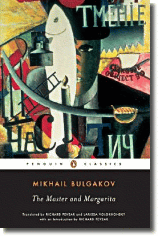
The Master and Margarita
by Mikhail Bulgakov

I read this when I was 18 and dressing at the National. The writer’s imagination is vivid and enthralling.
The Master and Margarita is one of Daniel Johnson's five best books about Cold War culture. It's also a book that English actor and writer Stephen Fry tries to read as often as he can.

Read about the other books on Fiennes' list.

--Marshal Zeringue

Sunday, March 21, 2010

Five best books on scandals

Henry E. Scott's Shocking True Story: The Rise and Fall of Confidential, "America's Scandalous Scandal Magazine" was recently published by Pantheon.

He named his five favorite books on scandals for the Wall Street Journal. One book on the list:
A Gospel of Shame
by Frank Bruni and Elinor Burkett

"A Gospel of Shame" is a disturbing account of religious scandal. New York Times reporter Frank Bruni and magazine writer Elinor Burkett put the reader in parochial-school classrooms and vividly conjure the terror felt by children subjected to gropings and worse by the priests who were supposed to be their moral shepherds. Bruni and Burkett also document the now well-known conspiracy by the Catholic Church hierarchy to cover up the child-abuse scandals. "Shame" opens with the story of 40-year-old Frank Fitzpatrick's 1990 telephone call to Father James Porter, his childhood priest at St. Mary's Church in North Attleboro, Mass. Fitzpatrick confronts him: Why did Porter molest Fitzpatrick and other children? The priest replies: "Who knows?"—and laughs.
Read about the other books on the list.

--Marshal Zeringue

Saturday, March 20, 2010

Ten of the best women writing as men

At the Guardian, John Mullan named a list of ten of the best women writing as men in literature.

One book on the list:
Ethan Frome by Edith Wharton

Wharton's story is told by a nameless young man, who has been sent by his employers to the small town of Starkfield in wintry New England. He is intrigued by the mysterious Ethan, whom he hires as his driver. Thus we get access to the tale of Ethan's passion for Mattie, his wife's cousin. It all ends in a very nasty sledging accident.
Read about the other books on the list.

Ethan Frome is one of Lynda Resnick's best books.

See Mullan's list of ten of the best men writing as women in literature.

--Marshal Zeringue