Wednesday, June 30, 2010

Top 10 African crime novels

Michael Stanley is the writing team of native Africans Michael Sears and Stanley Trollip.

They named their top ten crime novels for the Guardian. One title on the list:
Wife of the Gods by Kwei Quartey

2009 saw the debut of a talented Ghanian crime writer who lives in the United States. Inspector Darko Dawson is a detective in Accra, a moody and potentially violent man. He is asked to investigate a murder in the rural village of Ketanu where he has relatives. Soon he is embroiled with traditional beliefs and fetish priests juxtaposed with modern doctors and AIDS concerns. Kwei reveals the cultural conflicts of an African country trying to become a modern nation; many of the issues remind us of similar tensions in Botswana. Darko ponders these issues as he lights a joint, and slowly, with clever intuition and careful police work, homes in on the solution to the case. A solution he would rather not have found.
Read about the other novels on the list.

The Page 69 Test: Wife of the Gods.

--Marshal Zeringue

Tuesday, June 29, 2010

Books to inspire busy world leaders

At the Guardian, Robert McCrum named a few books to inspire busy public figures.

His suggestions for George Osborne, Britain's new Tory chancellor of the exchequer:
1. Hard Times by Charles Dickens

2. Sybil, or the Two Nations by Benjamin Disraeli

3. The Road to Wigan Pier by George Orwell
Read about the other books on McCrum's lists.

The Road to Wigan Pier appears on Ian Jack's list.

See The Page 99 Test for The Bolter by Frances Osborne, who is married to George Osborne.

--Marshal Zeringue

Monday, June 28, 2010

Six books that made a difference to Samantha Bee

The Daily Show correspondent Samantha Bee is the author of I Know I Am, but What Are You?

For O, The Oprah Magazine, she named a list of books that made a difference in her life. One book on her list:
Rabbit at Rest
by John Updike

In the last book in Updike's series about the life of Rabbit Angstrom, the character is in the most comfortable phase of his life financially and socially, but he's mired in nostalgia. I'm a little obsessed with stories about middle-aged men who can't grow up. I'm interested because I don't want to be blindsided by aging. I don't want to wake up one day and say, "Wait a second! Who is this person looking back at me?"
Read about the other books on Bee's list.

Updike's Rabbit, Run figures among Julian Barnes' best books to travel with, William Sutcliffe's top 10 relationship novels, and Aifric Campbell's top ten list of favorite jobs in fiction.

--Marshal Zeringue

Sunday, June 27, 2010

Ten of the best beaches in literature

For the Guardian, John Mullan named ten of the best beaches in literature.

One beach on the list:
On Chesil Beach by Ian McEwan

The Dorset beach is where Edward and Florence find themselves on the first night of their honeymoon, angrily venting their worst feelings after their first, disastrous attempt at sex. Chosen as a beautiful retreat for lovers, it is a stony place by moonlight – a bare stage for the couple's painful drama.
Read about the other literary beaches on Mullan's list.

On Chesil Beach also appears among Eli Gottlieb's top 10 scenes from the battle of the sexes, and on John Mullan's lists of ten best marital arguments in literature and ten of the best failed couplings in fiction.

--Marshal Zeringue

Saturday, June 26, 2010

Five best books on alcohol

Daniel Okrent was the first public editor of the New York Times, editor-at-large of Time, Inc., and managing editor of Life magazine. He worked in book publishing as an editor at Knopf and Viking, and was editor-in-chief of general books at Harcourt Brace. He was also a featured commentator on Ken Burns’s PBS series, Baseball, and is author of four books, one of which, Great Fortune, was a finalist for the 2004 Pulitzer Prize in history. Okrent was also a fellow at the Shorenstein Center at the Kennedy School of Government at Harvard, where he remains an Associate.

His new book is Last Call: The Rise and Fall of Prohibition.

For the Wall Street Journal, he named a five best list of books on alcohol. One title on his list:
Domesticating Drink by Catherine Gilbert Murdock
Johns Hopkins, 1998

Despite her subtitle, "Women, Men, and Alcohol in America, 1870-1940," Catherine Gilbert Murdock's primary subjects are female and her perspective decidedly feminist. But by focusing on women and drink—territory previously unexplored by scholars of her ability—she is able to tease out some of the puzzling and persistent anomalies and contradictions in American attitudes toward booze: women soldiers of the temperance movement co-existing with matrons who chugged Lydia E. Pinkham's Vegetable Compound (20.6% alcohol!) to alleviate their "female complaints"; the instant acceptance of women into the speakeasy, after they had been barred for decades from the saloon; and the absolutely decisive role of women in bringing about Prohibition's repeal, just they had been critical to its creation.
Read about the other books on the list.

The Page 99 Test: Daniel Okrent's Last Call.

--Marshal Zeringue

Friday, June 25, 2010

David Mitchell's six favorite books

David Mitchell is the author of Cloud Atlas and number9dream, both of which were finalists for the Man Booker Prize. His latest novel, The Thousand Autumns of Jacob de Zoet, will be published this month by Random House.

He named his six favorite books for The Week magazine.

One title on the list:
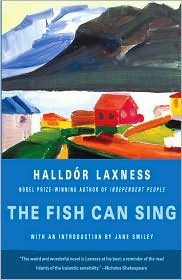
The Fish Can Sing by Halldór Laxness

An Arctic-lit thing of beauty about a houseful of misfits living outside Reykjavik, Iceland. Such is home to Álfgrímur, a boy who strikes up a sporadic but formative relationship with Iceland’s celebrated “world singer” Garoar Hólm. Hólm has a secret hanging around his neck, and Álfgrímur ultimately has a role in his redemption.
Read about the other books on the list.

David Mitchell's Cloud Atlas is one of Maile Meloy's six best books.

--Marshal Zeringue

Thursday, June 24, 2010

Thirty-five essential posthuman novels

"Science fiction has always asked what comes after Homo sapiens," writes Annalee Newitz at io9. "A superhuman version of our species, or a dying planet devoid of intelligent life? This list of 35 essential posthuman novels will get you started answering the big questions too."

One book on the list:
The World Without Us, by Alan Weisman

A futurist thought experiment, Weisman imagines what would happen to the planet if Homo sapiens disappeared tomorrow. Based on research and interviews, this work of narrative nonfiction reads like apocalyptic SF about the posthuman world.
Read about the other works on the list.

Writers Read: Alan Weisman.

--Marshal Zeringue

Wednesday, June 23, 2010

Top ten women travelers in fiction

Jennie Rooney's first novel, Inside the Whale, was shortlisted for the Costa first novel award in 2008. Her new novel, The Opposite of Falling, in which Ursula Bridgewater takes Thomas Cook's famous new tour of America after her engagement is broken off, is out now in the U.K.

For the Guardian, she named a top ten list of fiction's most engaging female adventurers. One entry on her list:
Clarissa Dalloway in Mrs Dalloway by Virginia Woolf

An interior journey, this one. Told through a stream-of-consciousness narrative, it is the story of Mrs Dalloway's preparations for a party that evening, and takes place over a single day in June. The action is mainly restricted to flashbacks, but by the end of the book, it is clear that this day has been a journey through Clarissa's mind.
Read about the other women travellers on the list.

Mrs. Dalloway also appears on John Mullan's list of ten of the best prime ministers in fiction, and among Michael Cunningham's 5 most important books, Dani Shapiro's 10 favorite books, and Kate Walbert's best books.

--Marshal Zeringue

Tuesday, June 22, 2010

Books that made a difference to Zoë Saldana

A few months ago the actor Zoë Saldana (Avatar) told O, The Oprah Magazine about a few books that made a difference to her.

One book on her list:
Lucy
by Jamaica Kincaid

Background:
Lucy is a Caribbean girl who travels to an unnamed North American city to work as an au pair for a very wealthy family. The story is set in the late '60s, when so many changes were happening and women were going through a very liberating time. Lucy is trying to find a home in this foreign society and also find her purpose.

Why she chose it:
My heritage is Caribbean, and I'd never read anything that really breaks down Caribbean culture politically, historically, socially, and in terms of gender. Lucy did that—it called out to me, to the kind of life I had and the kind of person I am. One thing I love about the book is how painfully honest Kincaid is about Lucy's issues with her mother. Lucy is fueled by pride and rebellion and pain, but the emotions guiding her at first aren't the ones driving her at the end of the story. She realizes she needs to make peace with the fact that no matter how far she might go in the world, she will never stop being her mother's daughter.
Read about the other books that made a difference to Saldana.

--Marshal Zeringue

Monday, June 21, 2010

Five best books about inventions

William Rosen is the author of The Most Powerful Idea in the World: A Story of Steam, Industry, and Invention.

For the Wall Street Journal, he named a five best list of books about inventions.

One title on the list:
The Making of the Atomic Bomb
by Richard Rhodes

Richard Rhodes's story of the birth of the nuclear age is an epic that, in terms of scientific discovery, unfolds in the blink of an eye—Hiroshima, after all, was destroyed just 34 years after the discovery of the atomic nucleus. His cast of characters is a virtual Who's Who of 20th-century physics, from Albert Einstein to J. Robert Oppenheimer, but one that also gives star turns to brilliant and dogged engineers like Vannevar Bush and Gen. Leslie Groves. Rhodes pays his readers the compliment of assuming that they are familiar enough with the story to foresee critical moments. We know, for instance, before Glenn Seaborg himself, that Seaborg will name element 94 ("this speck of matter God had not welcomed at the Creation," Rhodes writes) for the Roman god of the dead: plutonium.
Read about the other books on the list.

The Making of the Atomic Bomb is one of Michael Evans' top six books on nuclear war.

--Marshal Zeringue

Sunday, June 20, 2010

Ten of the best good doctors in literature

For the Guardian, John Mullan named ten of the best good doctors in literature.

One doctor on the list:
Henry Perowne

Perowne is a noted neurosurgeon and protagonist of Ian McEwan's Saturday. Only slightly less accomplished than Patrick O'Brian's] Maturin, this squash player and bon vivant has his comfortable world threatened by a criminal psychopath – whose life he saves in a properly doctorly fashion.
Read about the other doctors on the list.

Saturday also appears on Mullan's list of ten of the best prime ministers in fiction.

Also see Mullan's list of ten of the best fictional bad doctors.

--Marshal Zeringue

Saturday, June 19, 2010

Peter Mayle's six best books

Peter Mayle worked in advertising until he decided to live where he most longed to, Provence, and try his hand at writing. With the success of his first book describing his new life, A Year in Provence, his life took a notable turn for the better.

He told the Daily Express about his six best books.

One title on the list:
Master & Commander
by Patrick O’Brian

I love all 20 volumes of O’Brian’s fabulous sea saga. Indeed it’s better than the Hornblower series. It boasts great characters and is a good way to learn some history.
Read about the other books on Mayle's list.

The Aubrey/Maturin Series by Patrick O'Brian made Bella Bathurst's top ten list of books on the sea.

--Marshal Zeringue