Tuesday, August 31, 2010

Top 10 westerns of the decade

Bill Ott named the top ten westerns of the last decade (with an emphasis on more recent titles) for Booklist.

One title on the list:
Jericho’s Road. By Elmer Kelton

The sixth book in Kelton’s wonderful Texas Ranger series about the development of the Lone Star State during the turbulent 1800s deftly uses characters from past entries while folding in new personalities. This is arguably the best ongoing western series in the genre today.
Read about the other novels on the list.

--Marshal Zeringue

Monday, August 30, 2010

Five best books about extreme cold

Bill Streever, a biologist who lives and works in Alaska, is the author of Cold: Adventures in the World’s Frozen Places.

For the Wall Street Journal, he named a five best list of books about extreme cold. One title on the list:
The Children's Blizzard
by David Laskin

David Laskin applies his talent for personalizing history to the blizzard of 1888 on America's northern Plains. Kids go to school on a pleasant January morning, but then temperatures plummet without warning and blinding snow rushes in. Young Etta Shattuck, one of the storm's victims, takes refuge in a haystack, only to die later from complications of severe frostbite. "The Children's Blizzard" gives us a portrait of life on the American prairie just before the 20th century but also a story of hypothermia, of wind chill and of people becoming "cold stupid" as they try to find a safe haven. "The dulled mind," Laskin writes, "begins to throb around a single image—really more a sensation than an image: the craving for warmth." He believes that the brutal storm—it killed hundreds, many of them children—marked a turning point in the pioneer romance with an unforgiving land. Laskin also leaves us with a well-placed fear of severe cold's implacable danger.
Read about the other books on the list.

Read an excerpt from Cold, and learn more about the book and author at Bill Streever's website.

The Page 99 Test: Cold.

--Marshal Zeringue

Sunday, August 29, 2010

Ten of the best railway journeys

At the Guardian, John Mullan named ten of the best railway journeys in literature.

One novel on the list:
Possession, by AS Byatt

There comes a crucial moment in Byatt's tale of two modern-day academics who have discovered the love letters of two famous Victorian poets, when the story suddenly shifts to the 19th century. "The man and the woman sat opposite each other in the railway carriage." The train is the transport of illicit love.
Read about the other entries on the list.

Possession
also appears on John Mullan's lists of ten of the best locks of hair in fiction, ten of the best graveyard scenes in fiction, ten of the best lawyers in literature, and ten of the best dragons in literature, as well as on Christina Koning's top six romances critic's chart and among Elizabeth Kostova's top 10 books for winter nights.

--Marshal Zeringue

Saturday, August 28, 2010

Six books...to take to war

Patrick Hennessey was born in 1982 and educated at Berkhamsted School and Balliol College, Oxford, where he read English. He joined the Army in January 2004, undertaking officer training at the Royal Military Academy Sandhurst where he was awarded the Queen’s Medal and commissioned into The Grenadier Guards. He served as a Platoon Commander and later Company Operations Officer from the end of 2004 to early 2009 in the Balkans, Africa, South East Asia and the Falkland Islands and on operational tours to Iraq in 2006 and Afghanistan in 2007, where he became the youngest Captain in the Army and was commended for gallantry.

His book is The Junior Officers' Reading Club: Killing Time and Fighting Wars.

For The Week magazine, he recommended six books to take to war. One title on his list:
Catch-22 by Joseph Heller

I loved Heller’s masterpiece before I joined the British army, but didn’t realize how scarily accurate it was. War shouldn’t be laugh-out-loud funny, but it can be, and Heller’s book catches that expertly. Despite its dark humor, Catch-22 retains a glimmer of hope—“Yossarian lives.”
Read about the other books on Hennessey's list.

Catch-22 is among Jasper Fforde's five most important books, Thomas E. Ricks' top ten books about U.S. military history, and Antony Beevor's five best works of fiction about World War II. While it disappointed Nick Hornby upon rereading, it made Cracked magazine's "Wit Lit 101: Five Classic Novels That Bring the Funny."

--Marshal Zeringue

Friday, August 27, 2010

Top 10 books you were forced to read in school

TIME magazine came up with a list of the top ten books you were forced to read in school.

One title on the list:
To Kill a Mockingbird

Harper Lee's 1960 paean to the South is one of the most beloved American novels ever written. Some of that is due to the 1962 classic film adapted from it, which stars Gregory Peck as Atticus Finch, a small-town lawyer who also happens to be the most upstanding and sympathetic father ever. But much of the respect accorded the novel (the author's only book) has to do with its memorable main characters, brother and sister duo Jem and Scout. With its competing subplots about a black man on trial for allegedly raping a white woman and the children's attempts to learn about their reclusive neighbor Boo Radley, the novel is perfectly structured to provide half a dozen lessons about history and acceptance and injustice and compassion. No wonder it's the staple of all middle-school staples.
Read about the other books on the list.

To Kill a Mockingbird
also made John Mullan's list of ten of the best lawyers in literature, Lisa Scottoline's top ten list of books about justice, and Luke Leitch's list of ten literary one-hit wonders. It is one of Sanjeev Bhaskar's six best books.

--Marshal Zeringue

Thursday, August 26, 2010

Five classic chase novels

Louise Bagshawe is the author of twelve bestselling novels and a Conservative MP for Corby and East Northamptonshire.

One classic chase story she discussed with Anna Blundy at FiveBooks:
Eye of the Needle by Ken Follett

This is another terrific chase story with a bit more characterisation, Ken Follett’s first really big success as an author. It’s interesting because the protagonist is a German spy who has to transmit important information to Germany and he goes on the run to try to do it. He knows the British are staking out the locations of the D-Day landings and he is trying to get that information to Germany until the very end, when he falls in love. And the woman he falls in love with on a remote island in Scotland, is charged with tracking him down and killing him. Follett brings in more elements of psychology and of love and love gone wrong – the woman he falls in love with is the wife of a paralysed man and he tells some of that backstory, but again it’s a fascinating chase story with psycho-drama. It is fantastic. You’re in a weird position of wanting the German spy to fail, but at the same time you can’t help admiring his cleverness even though he is a psychopath.
Read about the other books on Bagshawe's list.

--Marshal Zeringue

Wednesday, August 25, 2010

Books that made a difference to Brian Williams

NBC news anchor Brian Williams told O, The Oprah Magazine about a short list of books that made a difference to him.

One title on the list:
The Life and Times of the Thunderbolt Kid
by Bill Bryson

Bryson's memoir of growing up in Des Moines captures the optimism of American life in the 1950s. "My wife gave this to me," says Williams. "She thought that I could use a little lightness in my reading. My memories as a kid are of a kind of clunky, grindingly middle-class America, where an American cheese slice individually wrapped was the biggest deal in the world. Also, a roasted marshmallow. And half a Popsicle—you had to get the crack absolutely right or someone got shortchanged. This book is how I grew up. I laughed through it in bursts, in paroxysms, in spasms."
Read about the other books on Williams' list.

Also see Brian Williams' favorite "portraits of Americans."

--Marshal Zeringue

Tuesday, August 24, 2010

Eoin Colfer's six favorite books

Eoin Colfer is the author of the bestselling Artemis Fowl series. He named his six favorite books for The Week Magazine.

One title on his list:
Any Human Heart by William Boyd

The story of a man’s life from beginning to end, with all the heartache and laughter that go along with such a journey. This book takes us to the final moment in all our lives, and it’s heartbreaking.
Read about the other books on Colfer's list.

Any Human Heart also appears on John Mullan's list of ten of the best novels about novelists.

--Marshal Zeringue

Monday, August 23, 2010

Ten of the best pigs in literature

At the Guardian, John Mullan named ten of the best pigs in literature.

One novel on the list:
Lord of the Flies by William Golding

"Kill the pig! Cut his throat! Kill the pig! Bash him in!'" All those angelic choirboys become true primitives when they learn to hunt and kill wild pigs on the idyllic, hellish island. The Lord of the Flies – a rotting pig's head, stuck on a stick – presides.
Read about the other entries on the list.

Lord of the Flies
is on AbeBooks' list of 20 books of shattered childhoods and is one of the top ten works of literature according to Stephen King. It appears on John Mullan's lists of ten of the best pairs of glasses in literature and ten of the best horrid children in literature, and William Skidelsky's list of ten of the best accounts of being marooned in literature. It is a book that made a difference to Isla Fisher.

--Marshal Zeringue

Sunday, August 22, 2010

Five best books on the oil industry

Peter Maass is a contributing writer to the New York Times Magazine and has reported from the Middle East, Asia, South America and Africa. He has written as well for The New Yorker, The Atlantic Monthly, the Washington Post and Slate. Maass is the author of Love Thy Neighbor: A Story of War, which chronicled the Bosnian war and won prizes from the Overseas Press Club and the Los Angeles Times.

His latest book is Crude World: The Violent Twilight of Oil.

For the Wall Street Journal, he named a five best list of books on the oil industry. One title on the list:
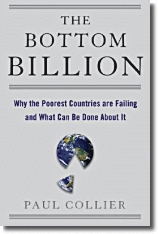
The Bottom Billion
by Paul Collier

Oil is an amazing product of nature, though not always in ways we expect. Its discovery, for instance, can do more harm than good to the countries where it is found. In what is known as the resource curse, some countries become poorer, not richer, as the influx of oil revenues deadens other economic growth and encourages corruption. Oil riches also tend to fire the imagination of aspiring dictators. Paul Collier explores the paradox of oil's baleful effects in revelatory detail in "The Bottom Billion." Collier, an Oxford professor and former World Bank official who blessedly writes like neither an academic nor a banker, doesn't restrict his argument to oil—plentiful supplies of gold, iron and other natural resources all can have deleterious effects on national development. Collier proposes a rescue of countries where the "bottom billion" reside, calling on the Group of Eight industrialized nations to institute preferential trade policies, do a better job of policing corruption and even consider military intervention.
Read about the other books on the list.

The Page 99 Test: The Bottom Billion.

Learn more about Crude World and its author at Peter Maass' website and blog.

The Page 99 Test: Crude World.

--Marshal Zeringue

Saturday, August 21, 2010

Ten favorite San Francisco-backdropped crime novels

Janet Rudolph is the organizer of Mystery Readers International and the editor of Mystery Readers Journal. She also blogs at Mystery Fanfare.

She named her ten favorite San Francisco-backdropped crime novels for The Rap Sheet. One title on the list:
The Maltese Falcon (1930), by Dashiell Hammett.

The quintessential San Francisco mystery--the alleys, streets, fog, and noir of the City by the Bay. Sam Spade is the most famous San Francisco detective. No further explanation needed.
Read about the other books on the list.

The Maltese Falcon appears on John Mullan's list of ten of the best femmes fatales in literature.

--Marshal Zeringue

Friday, August 20, 2010

Twenty book covers featuring body parts

Emily Temple posted twenty gorgeously designed book covers featuring body parts at Flavorwire.

One book cover to make the grade: How to Be Inappropriate, a collection of humorous nonfiction by Daniel Nester, a journalist, essayist, poet, editor, and teacher.

Nester's first two books, God Save My Queen (Soft Skull Press, 2003) and God Save My Queen II (2004), are collections on his obsession with the rock band Queen. His third, The History of My World Tonight (BlazeVOX, 2006), is a collection of poems.

Among the praise for How to Be Inappropriate:
A "deeply funny new collection of booger-flecked nonfiction"
--Time Out New York

"His stories are, as the title suggests, inappropriate, and they often engender squeamishness, discomfort, and laughter. But they are fresh and, at times, touching, qualities that make this an enjoyable read."
--Library Journal

"One of the year's funniest books."
--Largehearted Boy
Visit Daniel Nester's website.

Writers Read: Daniel Nester.

Check out the other book covers.

--Marshal Zeringue