Tuesday, September 10, 2019

Nine jazz-infused crime novels

Alex Segura is a novelist and comic book writer. He is the author of the Pete Fernandez Miami Mystery novels, all via Polis Books.

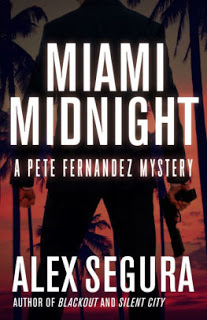
Segura's latest book is Miami Midnight.

One of the author's favorite jazz-infused crime novels, as shared at CrimeReads:
Knots and Crosses, Ian Rankin

Though Rankin’s Inspector Rebus has become more known for his affinity for artists like The Rolling Stones and Muddy Waters, the early Rebus novels feature the scruffy detective leaning more toward classical and jazz. But as Rankin got to explore his creation’s habits more, readers saw his musical tastes updated. Also, the introduction of younger characters later in the series opened the door to more modern acts, like Belle and Sebastian. Like the Bosch books, you’re well served starting at the beginning—with Rankin’s sharp, blue-collar, and evocative Knots and Crosses.
Read about the other entries on the list.

--Marshal Zeringue

Monday, September 9, 2019

Seven books about remaking the world

Annalee Newitz is an American journalist, editor, and author of fiction and nonfiction. They are the recipient of a Knight Science Journalism Fellowship from MIT, and have written for Popular Science, The New Yorker, and the Washington Post. They founded the science fiction website io9 and served as Editor-in-Chief from 2008–2015, and then became Editor-in-Chief at Gizmodo and Tech Culture Editor at Ars Technica. Their book Scatter, Adapt, and Remember: How Humans Will Survive a Mass Extinction was nominated for the LA Times Book Prize in science. Their first novel, Autonomous, won a Lambda award. The Future of Another Timeline is Newitz's latest book.

At Tor.com they tagged "seven works that define the new subgenre of geoscience fiction," including:
The Murderbot series by Martha Wells and the Cordelia’s Honor duology by Lois McMaster Bujold

I wanted to mention these two series together because they both feature heroes who are part of planetary survey teams. This is an old trope in science fiction, and shows up a lot in Golden Age stories about people exploring other worlds. Often they’re taking environmental samples and studying geology for the purpose of future mining operations. The Murderbot series begins with a group landing on a planet and studying it for resource exploitation, while the Cordelia’s team in Bujold’s duology—which began her legendary Vorkosigan Saga—appear to be doing basic research for scientific discovery. Either way, the planetary survey team is key to geoscience fiction because they treat planets as holistic systems, looking at everything from their internal composition and ecosystems, to atmosphere and magnetic field.
Read about the other entries on the list.

All Systems Red also appears among Tansy Rayner Roberts and Rivqa Rafael's five top books that give voice to artificial intelligence, T.W. O'Brien's five recent books that explore the secret lives of robots, Sam Reader's top six science fiction novels for fans of Westworld, and Nicole Hill's six robots too smart for their own good.

--Marshal Zeringue

Books to help make sense of parliament

Isabel Hardman is a journalist and broadcaster. She is Assistant Editor of The Spectator and presents Week in Westminster on BBC Radio 4. In 2015, she was named "Journalist of the Year" at the Political Studies Association's annual awards.

Hardman is the author of Why We Get the Wrong Politicians.

At the Guardian she tagged six of the best titles that explain what is happening in UK politics, including:
People very rarely lie in Westminster. This might sound absurd, but it’s true. What they do is use their words so carefully that only a linguist experienced in politicalese can translate what they actually mean. If a government says it “isn’t considering” proroguing parliament – as it did recently, before doing just that – this doesn’t necessarily mean that it isn’t going to prorogue parliament. The key is the verb: advisers will argue it doesn’t cover a decision that has already been taken. The best lexicon is the very entertaining Would They Lie to You? by Robert Hutton, which will help you understand what politicians are actually saying, while also making you profoundly dispirited about the way politics is conducted. See also Peter Oborne’s The Rise of Political Lying and The Triumph of the Political Class.
Read about the other entries on the list.

--Marshal Zeringue

Sunday, September 8, 2019

Seven top international thrillers with female protagonists

As an investigative journalist, Holly Watt has written about the refugee crisis, traveling to Libya, Lebanon, and Zaatari refugee camps in Jordan, and covered stories ranging from the Panama Papers to chasing modern-day pirates in the Indian Ocean. She has written for the Sunday Times, the Telegraph, and the Guardian. She lives in London. To the Lions is her first novel.

At CrimeReads, Watt tagged seven of her favorite international thrillers with female protagonists, including:
Sweet Caress, by William Boyd

This isn’t one of Boyd’s thrillers, but the glamorous, globetrotting life of Amory Clay is undoubtedly thrilling. Clay’s adventures—mainly as a photographer—take her across Europe and off to Vietnam before she journeys on to California and Scotland. In this novel, Boyd swirls together fact and fiction, borrowing real elements from the lives of several ground-breaking women, including the photographer Lee Miller and the journalist Martha Gellhorn, as he builds up this portrayal of a brave, bold, adventuring woman.
Read about the other entries on the list.

--Marshal Zeringue

Saturday, September 7, 2019

Lore Segal's ten desert island books

Lore Segal is the author of the Pulitzer Prize finalist Shakespeare’s Kitchen, as well as the novels Half the Kingdom, Lucinella, Other People’s Houses, and Her First American. She is the recipient of the American Academy and the Institutes of Arts and Letters Award, a Guggenheim Fellowship, The O’Henry Prize, and the Harold U. Ribalow Prize. She has written for The New Yorker, The New York Times Book Review, The New Republic, and other publications. She also writes children’s books and translates from the German.

Segal's newest book is The Journal I Did Not Keep.

One of the author's ten favorite books, as shared at Vulture.com:
Michael Kohlhaas, Heinrich Von Kleist

A landowner who must move his horses across another man’s property gets into a minor altercation. The hassle which would seem to be easy enough to settle escalates beyond the possibility of repair. We read on with a horrified recognition: This is how one set of humans gets into war with another.
Read about the other entries on the list.

--Marshal Zeringue

Friday, September 6, 2019

Seven essential contagion novels

David Koepp is a celebrated American screenwriter and director best known for his work on Jurassic Park, Spider-Man, Panic Room, War of the Worlds and Mission: Impossible. His work on screen has grossed over $6 billion worldwide.

Koepp's new novel is Cold Storage.

At CrimeReads the author tagged seven of his favorite contagion novels, including:
I Am Legend, by Richard Matheson

I Am Legend tops my list of seven essential contagion novels not just for the tender age at which I read it—and how many of my still-forming mental synapses were created or closed off by its horrors—but because of the genius of its simplicity. Vampirism is a communicable disease. The sharp edges of that premise cut clean; it’s an idea at once groundbreaking and obvious. Of COURSE this book had to exist. Written in 1954, it was in the middle of Matheson’s legendary streak of compelling fantasy work, a run that included The Shrinking Man (1956), A Stir of Echoes (1958), and most of the best Twilight Zones. Yowza! Interesting side note—I Am Legend has been made into a movie four times, but never once has a filmmaker had the nerve to shoot the chills-down-your-back, everything-is-clear-now ending of the book. Still one of the darkest and most beautiful closing passages I’ve ever read.
Read about the other entries on the list.

I Am Legend is among Jeff Somers's five notable books totally unlike their adaptations, Jonathan Hatfull's ten best vampire novels ever, Jennifer Griffith Delgado's top eleven mind-blowing surprise endings in science fiction and fantasy literature and Kevin Jackson's top ten vampire novels.

--Marshal Zeringue

Thursday, September 5, 2019

Ten top books about fake news

Henry Hemming is the bestselling author of six books including M, published as Agent M in North America, the Dolman Travel Award-shortlisted Misadventure in the Middle East and the New York Times bestseller The Ingenious Mr Pyke.

His new book is Agents of Influence: A British Campaign, a Canadian Spy, and the Secret Plot to Bring America into World War II.

At the Guardian, Hemming tagged ten top books about fake news, including:
Restless by William Boyd (2006)

Our narrator, Ruth, learns that her mother is not everything she seems. Via a stream of flashbacks we learn about her time working for “British Security Coordination”, the cover name used for the real British influence campaign in 1941. This is not so much a spy thriller as a novel about spies, that is thrilling as well as taut, emotionally rich, brilliantly researched and ultimately a powerful examination of the burden of espionage.
Read about the other entries on the list.

Restless is among Samuel Muston's ten best spy novels.

--Marshal Zeringue

Wednesday, September 4, 2019

Joanna Kavenna's favorite books on surveillance

Joanna Kavenna grew up in various parts of Britain, and has also lived in the USA, France, Germany, Scandinavia and the Baltic States. Her first book The Ice Museum was about traveling in the remote North, among other things. Her second was a novel called Inglorious, which won the Orange Award for New Writing. It was followed by a novel called The Birth of Love, which was longlisted for the Orange Prize. Then came her novel Come to the Edge, a satire. Kavenna's latest novel is Zed, "a blistering, satirical novel about life under a global media and tech corporation that knows exactly what we think, what we want, and what we do--before we do."

At the Guardian, Kavenna shared her favorite books that reveal how we are scrutinized, including:
The Russian author Yevgeny Zamyatin’s novel We was banned by the Soviet censorship board in 1921, appearing in an English translation three years later. He describes a future society in which all the buildings are made of glass so – like the panopticon – everyone can be seen at all times. Orwell reviewed We in 1946, three years before echoing Bentham in his own novel, Nineteen Eighty-Four: “There was of course no way of knowing whether you were being watched at any given moment. You had to live … in the assumption that every sound you made was overheard, and, except in darkness, every movement scrutinised.”
Read about the other titles on the list.

We is among Mark Skinner's five great literary dystopias, Christopher Hill's top ten books about tyrants, Weston Williams's fifteen classic science fiction books, and Lawrence Norfolk's five most memorable dystopias in fiction.

--Marshal Zeringue

Tuesday, September 3, 2019

The fifty greatest coming-of-age novels

Emily Temple is a senior editor at Lit Hub. Her first novel, The Lightness, will be published by William Morrow in 2020.

At LitHub she tagged fifty of the greatest coming-of-age novels, including:
Tayari Jones, Silver Sparrow

This compelling novel also features one of the best opening lines in contemporary literature: “My father, James Witherspoon, is a bigamist.” Don’t tell me you won’t keep reading after that—especially because what follows is the double-coming-of-age of Dana Lynn Yarbor and Bunny Chaurisse Witherspoon; when it begins, the former knows all about the latter, who knows nothing—but soon will.
Read about the other entries on the list.

Silver Sparrow is among Kyle Minor's fifteen hottest affairs in literature.

--Marshal Zeringue

Monday, September 2, 2019

Six top social justice books

Karin Slaughter is one of the world's most popular and acclaimed storytellers. Published in 37 languages, with more than 35 million copies sold across the globe, her nineteen novels include the Grant County and Will Trent books, as well as the Edgar-nominated Cop Town and the instant New York Times bestselling novels Pretty Girls and The Good Daughter. Her most recent novel, The Last Widow, features Sara Linton and Will Trent. A native of Georgia, Slaughter currently lives in Atlanta. Her novels Cop Town, The Good Daughter, and Pieces of Her are all in development for film and television.

At The Week magazine, Slaughter tagged six of her favorite social justice books, including:
American Terrorist by Lou Michel and Dan Herbeck (2001).

There is very little daylight between Tim­o­thy McVeigh's perverse dogma (captured during 75 hours of interviews) and what we're hearing from white supremacist ex­trem­ists today. The man who bombed an Okla­ho­ma City federal building in 1995 was not a lone wolf. He was immersed in a white power movement with tentacles that have reached from Charles­ton to Char­lottes­ville to Christ­church and back again.
Read about the other entries on the list.

--Marshal Zeringue

Sunday, September 1, 2019

Five top books on race in Britain

Nikesh Shukla is a British writer and diversity activist who conceived and edited The Good Immigrant, the acclaimed collection of essays about race and immigration by 21 writers of color. He is the editor of Rife Magazine, an online magazine for young people, and the author of the novels Coconut Unlimited which was shortlisted for the Costa First Novel Award, and Meatspace. He has been shortlisted for the Liberty Human Rights Arts Award and named as one of Foreign Policy's 100 Global Thinkers 2016. His third novel, The One Who Wrote Destiny, and his first YA novel, Run, Riot, were published in 2018.

At the Guardian Shukla tagged five indispensable books on race in Britain, including:
Reni Eddo-Lodge’s award-winning book Why I’m No Longer Talking to White People About Race is a great place to start when trying to understand Britain’s relationship with race and racism. It interrogates whiteness and white privilege and asks us to look at issues around class, sexism, the way our education system is set up and how we relate to each other online and in person. It contains a wonderfully expansive look at the history of black British people and also prompts us to ask ourselves fundamentally uncomfortable questions. Her writing is urgent and powerful and I’ve seen how the book has resonated with young people of colour.
Read about the other entries on the list.

--Marshal Zeringue

Six books to help you love your enemies

Julie Myerson is an English author and critic.

At the Guardian she tagged six books that can help you to love your enemies, including:
Anger: Buddhist Wisdom for Cooling the Flames, by Buddhist monk Thich Nhat Hanh, helped me see my own “enemies” for exactly what they were: ordinary, inept and helpless beings who, like me, could be assuaged with understanding and forgiveness.
Read about the other entries on the list.

--Marshal Zeringue