Tuesday, April 30, 2013

Top ten books about cities

Leo Hollis was born in London in 1972, was educated at Stoneyhurst College and studied history at university. He is the author of number books on London including London Rising: The Men Who Made Modern London and Cities Are Good for You: The Genius of the Metropolis.

For the Guardian he tagged ten top books about cities, including:
Behind the Beautiful Forevers by Katherine Boo

A brilliant and tireless work of journalism set in the slums close to Mumbai airport. Katherine Boo spent time talking to and observing the many characters who are given such full life in her pages. She does not come up with easy solutions, nor does she turn away from horrors – yet she allows individual lives to have their own dignity. There has been so much debate about the informal city and the economic potential of slums that it is worthwhile recalling the people who live there and the challenges they face.
Read about the other entries on the list.

Learn about Hollis's list of five notable books on why cities are good for you.

Also see: The top 10 cities in literature, Simon Jenkins's five best books on cities, and Pete Hamill's five best books about cities.

--Marshal Zeringue

Monday, April 29, 2013

David Chase's six favorite books

David Chase is the creator of The Sopranos and the writer-director of the 2012 feature film Not Fade Away.

One of his six favorite books, as told to The Week magazine:
I, Claudius by Robert Graves

Graves's novel about Rome in the 1st century B.C. is a real trip back in time. When you're reading it, you want to go there every day. You want to follow events there, instead of the ones in your own life, because they're so startling.
Read about the other books on Chase's list.

I, Claudius also appears on Andrew Miller's top ten list of historical novels, Mark Malloch-Brown's list of his six favorite novels of empire, Annabel Lyon's top ten list of books on the ancient world, Lindsey Davis' top ten list of Roman books, and John Mullan's lists of ten of the best emperors in literature and ten of the best poisonings in literature.

--Marshal Zeringue

Sunday, April 28, 2013

Danny Wallace's six best books

Danny Wallace is a writer, producer, and award-winning journalist whose work has appeared in numerous newspapers and magazines. He has written a weekly column in the U.K. magazine ShortList since 2007, and his past books include Join Me and Yes Man, which was made into a feature film starring Jim Carrey.

Wallace's novel Charlotte Street was the third bestselling debut novel of 2012 in the U.K.

One of his six favorite books, as told to the Daily Express:
CASINO ROYALE by Ian Fleming

Where it all began, for Bond… and it's fascinating to see how far away the real James Bond is from the majority of the films. He's a thug, brutal, non-cerebral and pretty much just a human weapon. There's a lot of Ian Fleming in the spare prose, too.
Read about the other books on Wallace's list.

Casino Royale also made Mary Horlock's list of the five best psychos in fiction, John Mullan's list of ten of the best floggings in fiction, Meg Rosoff's top 10 adult books for teenagers list, and Peter Millar's critic's chart of top spy books.

--Marshal Zeringue

Saturday, April 27, 2013

Five top books on artists who've captivated our culture

One title on the Barnes & Noble Review's list of five top books on artists who have captivated our culture:
The Painted Girls
by Cathy Marie Buchanan

Who had a better eyewitness view of French master Edgar Degas than one of his ballerina muses, Marie van Boethem? Cathy Marie Buchanan imagines what adolescence may have been like for young Boethem during La Belle Époque, when she was immortalized in a number of Degas's renowned paintings and his only exhibited sculpture, Little Girl Aged Fourteen. Within, we are treated to glimpses of Degas at work, and of his subject's impressions of the Impressionist: "These girls, Monsieur Degas is saying, do not be tricked by the grace of their backs. These girls are of common stock."
Read about the other books on the list.

The Page 69 Test: The Painted Girls.

My Book, The Movie: The Painted Girls.

Writers Read: Cathy Marie Buchanan.

--Marshal Zeringue

Friday, April 26, 2013

Top ten books about being different

Gillian Cross won the 1990 Carnegie Medal for Wolf and the 1992 Whitbread Children's Book Award for The Great Elephant Chase.

For the Guardian she named her top ten books that throw everything you think you know upside down, including:
River Town by Peter Hessler

Peter Hessler spent two years in China, teaching in a small town on the Yangtze, around fifteen years ago. He describes his day to day life and how he gradually came to feel at home in the town and make friends with local people. There are many more up-to-date books about China, but when I was in Beijing last month, this is the book everyone told me to read, to understand what life was like beyond the big cities.
Read about the other books on the list.

River Town also appears among Hilary Spurling's top ten Chinese books, Rory Stewart's favorite travel books, and Oliver August's five best guides to China and its history.

--Marshal Zeringue

Thursday, April 25, 2013

The ten greatest prison breaks in sci-fi & fantasy

Charlie Jane Anders, editor at io9, named the ten greatest prison breaks in science fiction and fantasy. Most are from film and television, but literary escapes include:
Harry Potter and the Prisoner of Azkaban

Azkaban is the ultimate escape-proof wizard prison — guarded by Dementors and surrounded by the North Sea. Sirius Black is locked up there for years, trying over and over to break out, until finally he becomes the first wizard to get out. He finally manages to turn himself into his canine Animagus form, which is emaciated enough to slip through the bars and sneak past the Dementors undetected. Then he swims across the North Sea, nearly dying in the attempt. At last, he catches up with Harry Potter — only to be suspected of wanting to kill him.
Read about the other prison breaks.

Harry Potter and the Philosopher's Stone also appears on John Mullan's lists of ten of the best owls in literature, ten of the best scars in fiction and ten of the best motorbikes in literature, and Katharine Trendacosta and Charlie Jane Anders's list of the ten greatest personality tests in sci-fi & fantasy, Charlie Higson's top 10 list of fantasy books for children, Justin Scroggie's top ten list of books with secret signs as well as Charlie Jane Anders and Michael Ann Dobbs's list of well-known and beloved science fiction and fantasy novels that publishers didn't want to touch. Harry Potter and the Goblet of Fire made John Mullan's list of ten best graveyard scenes in fiction.

The Harry Potter books made Cressida Cowell's list of ten notable mythical creatures and Alison Flood's list of the top 10 most frequently stolen books.

Dolores Umbridge is among Emerald Fennell's top ten villainesses in literature and Derek Landy's top 10 villains in children's books. The Burrow is one of Elizabeth Wilhide's nine most memorable manors in literature.

--Marshal Zeringue

Wednesday, April 24, 2013

Ten of the best books set in Barcelona

Malcolm Burgess is the publisher of Oxygen Books' City-Lit series, featuring writing on cities including Berlin, Paris, London, Amsterdam, Venice and Dublin.

For the Guardian, in 2011 he named ten of the best books set in Barcelona, including:
Carlos Ruiz Zafón, The Shadow of the Wind, 2001

The marvellous gothic literary thriller, set in the aftermath of the Spanish civil war, that leaves no Barcelonan carrer or plaça unvisited!

"Els Quatre Gats was just a five-minute walk from our house and one of my favourite haunts … Inside, voices seemed to echo with shadows of other times. Accountants, dreamers, and would-be geniuses shared tables with the spectres of Pablo Picasso, Isaac Albéniz, Federico García Lorca and Salvador Dalí."
• Carrer Montsió
Read about the other books on the list.

Learn about Carlos Ruiz Zafón's top 10 20th-century gothic novels.

--Marshal Zeringue

Tuesday, April 23, 2013

Ten of the best Shakespeare characters

Today is Shakespeare's birthday. For the Guardian, in 2012 Robert McCrum came up with a list of the ten best Shakespeare characters, including:
The Nurse: Romeo and Juliet

Juliet’s nurse is a character who seems to have stepped straight off the high street in Stratford. It’s quite a small role, only 9% of the text, according to the RSC Shakespeare, but it gives the obsessive, all-consuming passion of the star-cross’d lovers a vital human counterpoint. The nurse is as garrulous as Polonius but grounded in everyday life, with a heart of gold. A wonderful crowd-pleaser, she provides, for Shakespeare, a point of contact with the audience for whom this tragic version of Pyramus and Thisbe might seem, in Romeo’s own words, “too flattering-sweet to be substantial.”
Read about the other characters on the list.

Also see: Ten notable Romeo and Juliet stories.

--Marshal Zeringue

Monday, April 22, 2013

Five top books on growing up in the Anthropocene

"The essential idea behind [the term "Anthropocene"]," writes Caspar Henderson, author of The Book of Barely Imagined Beings, "is that the impact of humanity as a whole on the Earth system – notably through destruction of natural habitats and a rapid increase in atmospheric concentrations of greenhouse gases – is now so great as to mark a new epoch in the history of life."

At The Browser, Henderson tagged five top books on growing up in the Anthropocene, including:
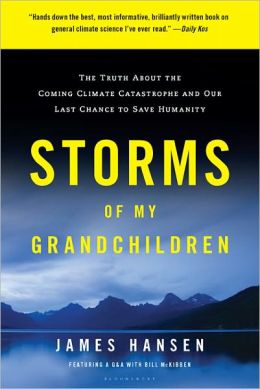
Storms of My Grandchildren by James Hansen.

Henderson: There are many good books for the general reader about the science, the politics, the economics and the psychology of climate change, and it is invidious to single out one or even a few. The Discovery of Global Warming by Spencer Weart, Field Notes from a Catastrophe by Elizabeth Kolbert, Sustainable Energy Without the Hot Air by David McKay, Merchants of Doubt by Naomi Oreskes and Erik Conway, and Eaarth by Bill McKibben are among those worth attention. Greg Craven, a high school science teacher in the US, developed his excellent talks on YouTube into a book called What's the Worst that Can Happen?, and I'd also recommend that.

But if I had to recommend just one book it would be James Hansen's Storms of My Grandchildren because it is, simultaneously, a good introduction to the science, a first-hand account of what it's like to be on the receiving end of attempted sabotage by political operatives who know nothing about the science, and a very human call for action. The book is dedicated to his grandchildren, Sophie and Connor, for whose future he fears in a rapidly warming world.  It also contains a manifesto for  how to address the challenges which, whether or not one agrees with every detail, is as good as any of the necessarily brief outlines you can find in books of this kind.

Hansen, who has just announced that he is stepping down as Director of the NASA Goddard Institute for Space Studies, is a distinguished climate scientist, but one of the things that really marks him out is his passionate commitment to making change happen. Hansen has been unusually outspoken among scientists for a long time. He first came to prominence in 1988, when he testified to the US Senate that he was “99% confident” that the Earth was warming because of human-made greenhouse gases.  He stood up to the administration of George W. Bush when it tried to censor him. And he's put himself on the line, being arrested for demonstrating against mountain top removal mining.  He has been a clear and authoritative voice against the Keystone pipeline, which would bring oil from the highly polluting Athabasca tar sands in Canada to US refineries.  It is precisely because he wants to commit himself full time to activism that he has stood down from his scientific work.

Hansen has been criticised for giving undue stress to the more extreme scenarios within the range of probability if we fail to drastically reduce emissions greenhouse gases. He fears an extinction event comparable to the “great dying” at the end of the Permian period 252 million years ago is a real risk. He's also criticised for being unrealistic in calling for emissions of greenhouse gases to be limited such that atmospheric concentrations do not exceed 350 parts per million – a goal adopted by the campaign group 350.org. These criticisms are worth entertaining but in an unreasonable world, where the functional stupidity of our societies and governments with regard to climate and environment is greater even than the dysfunction embedded in regulation of financial systems before the crash of 2007, a little unreasonableness may be the most reasonable thing.  Hansen has earned the right to speak. We should listen.
Read about the other books Henderson tagged at The Browser.

--Marshal Zeringue

Sunday, April 21, 2013

Five top autobiographical works putatively devoted to other subjects

Sarah Manguso's memoir is The Guardians: An Elegy for a Friend.

One of her five favorite examples of autobiographical writing putatively devoted to other subjects, as told to The Daily Beast:
Monster in a Box by Spalding Gray

Monster is a dramatic monologue, in Gray’s own words “a monologue about a man who can’t write a book about a man who can’t take a vacation.” Plagued by his unfinished 1,800-page novel, the eponymous Monster, Gray seeks to escape it through constant travel. Yet wherever he goes—as it is said—there he is, contained in a Protestant halo of exquisite self-awareness.
Read about the other entries on the list.

--Marshal Zeringue

Saturday, April 20, 2013

Five best books on lovers touching hands

André Aciman is the author of Out of Egypt (1995) and, most recently, Harvard Square, a novel.

One of his five best books on lovers touching hands, as told to the Wall Street Journal:
The Red and the Black
by Stendhal (1830)

The story of a young man's rise in 19th-century Paris would proceed along predictable lines if it weren't layered with Stendhal's piercing genius. He takes Julien Sorel, a naïve carpenter's son from the provinces, and hurls him into a universe of treachery and double-dealing. Torn between the army and the church, Julien, who has no less kindness than gumption in his heart, settles for seduction. One evening he reaches for the hand of his employer's wife. Shocked but unwilling to cause an uproar, she withdraws it. The next evening, he vows to try holding her hand again or else blow his brains out. When they are both sitting out in the garden, he reaches for it, and again she pulls away. Undaunted, he seizes her hand and holds it with "convulsive strength." This is not an amorous pass but a martial siege. Stendhal never says outright that she yields; rather he says something that only the passive voice conveys in English: "A final effort was made to withdraw it, but in the end, this hand remained in his." It turns out the lady was more in love with Julien than he ever dreamed. As for his feelings, the jury is still out.
Read about the other books on the list.

The Red and the Black is among John Banville's five best books on early love and the flush of infatuation, Warren Adler's five best books about ambition, and Norman Mailer's top ten works of literature.

--Marshal Zeringue

Friday, April 19, 2013

Ten picture books that would make great puppet shows

Polly Dunbar is co-founder of the UK-based puppet company Long Nose News. She and Katherine Morton have adapted four picture books into stage shows.

For the Guardian, Dunbar named ten other picture books that would make great puppet shows, including:
In the Night Kitchen by Maurice Sendak

This is a dark and twinkly book, and transports the reader in a theatrical, almost dreamlike way. The kitchen/cityscape evokes a stage set, the menacing bakers have a "Laurel and Hardy" air about them; I like that they might eat Mickey – the boy hero who finds himself in their cookery – at any moment. The whole audience would chant "Milk in the batter, milk in the batter, we bake cake and nothing's the matter" like a spell. Baking smells would waft out over the audience; everybody would be given a freshly-baked cake as they emerged from the dark theatre out in to the daylight. "And that's why thanks to Mickey we have cake every morning."
Read about the other stories on the list.

--Marshal Zeringue