Thursday, August 31, 2017

Five top MG books about going back to school

At the BN Kids Blog Rachel Sarah tagged "five realistic contemporary novels, both new and classic stories [that] will help both reluctant and ravenous readers face the unknown and also feel brave enough to take risks," including:
Are You There God? It’s Me, Margaret, by Judy Blume

I’ll always feel grateful to Judy Blume for being the first author to push the boundaries and really give middle grade readers a glimpse of what it’s like when your body starts to change, or when you wish it would finally would. (“We must, we must, we must increase our busts.”)

I’ve read this classic many times since I first picked it up the summer before I started middle school. I adore Margaret Simon, who wonders out loud if she’ll ever fill out her bra or get her period. Margaret has just moved from New York City to the suburbs, and she’s anxious about starting a new life in the suburbs at a new school.

For parents of kids who are going to start middle school soon, Are You There God? It’s Me, Margaret might be the perfect conversation starter to open the door to talking about some big worries on their minds.
Read about the other entries on the list.

--Marshal Zeringue

Five novels where the hero doesn’t save the day

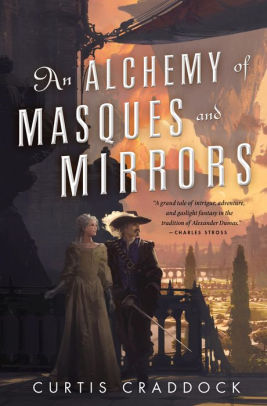
Curtis Craddock lives in Aurora, Colorado, where he teaches Computer Information Systems classes to offenders at a correctional facility. The newly released An Alchemy of Masques and Mirrors is his first book.

One of his five favorite books where the hero doesn’t save the day, as shared at Tor.com:
Fahrenheit 451 by Ray Bradbury

A book that features burning books as a central trope is in a pretty dark place to begin with. Guy Montag, a Fireman employed to perform this villainous task, has second thoughts about his occupation. The story deeply explores the notion of censorship and the dumbing down of media as a form of pacification, which is more relevant today than ever. It’s a dire warning about the seductiveness of the easy path. With nuclear war being a thing in this future, Montag doesn’t manage to save the day, but then who really can save a world without books?
Read about the other entries on the list.

Fahrenheit 451 is among Jeff Somers's six often misunderstood SF/F novels and on Alice-Azania Jarvis' reading list on firefighting.

--Marshal Zeringue

Wednesday, August 30, 2017

Top ten books on postwar France

Alex Christofi is a writer and editor living in London. His latest novel, Let Us Be True, is set in 60s Paris. One of his ten top books on postwar France, as shared at the Guardian:
Bonjour Tristesse by Françoise Sagan (1954)

Sagan was only 18 when her debut novel became a sensation. In the years before the yé-yé girls and sexual liberation of the 60s, it was remarkable for presenting an emancipated young woman – albeit one who has an oddly Oedipal relationship with her father – living the high life on the Riviera. The novel is jammed awkwardly into the form of a Wildean morality tale, but the sins are related with such gusto that no one ever remembers the moral.
Bonjour Tristesse is among Helena Frith Powell's five notable books on glamour.

Read about the other entries on the list.

--Marshal Zeringue

Tuesday, August 29, 2017

Fifty of the most essential high school stories

At the B&N Reads blog Brian Boone tagged fifty of the most essential high school stories, including:
Dare Me, by Megan Abbott

Here’s a book that’s sympathetic to the cheerleaders and mean girls. Dare Me both humanizes and subverts the typical way cheerleaders are written in teen stories, in which they’re almost always the villains, ruling the school with fear and bullying. That seems to have worked just fine for varsity cheerleaders Addy and Beth in the past, until a new coach divides, conquers, and unites them again, even as the police get involved in some very bad, bad things.
Read about the other entries on the list.

Dare Me is among Julie Buntin's twelve books that totally get female friendship, L.S. Hilton's top ten female-fronted thrillers, Megan Reynolds's top ten books you must read if you loved Gone Girl, Anna Fitzpatrick's four top horror stories set in the real universe of girlhood and Adam Sternbergh's six notable crime novels that double as great literature.

--Marshal Zeringue

Four books that changed Rachel Seiffert

Rachel Seiffert's most recent novel is A Boy in Winter.

One of four books that changed the author, as shared at the Sydney Morning Herald:
WASHINGTON SQUARE
Henry James

A father and daughter disagree over a suitor in 19th-century polite New York society. I read this out of desperation on a rainy family holiday as a 16-year-old, having taken too few books along. My mum had just finished it, and she passed it on to me to stop me complaining of boredom. "Nothing's happened yet," I kept reporting back to her every few pages. But I was hooked! It marks the point where I became a grown-up as a reader: plot isn't everything – not when you have characters with such rich interior lives to explore.
Read about the other books on the list.

Washington Square is among four books that changed Ian McGuire, five books that changed Carol Wall, and Will Eaves's top ten siblings' stories.

--Marshal Zeringue

Monday, August 28, 2017

Five books to help middle schoolers make and find real friends

At the BN Kids Blog Rachel Sarah tagged five "witty, honest novels about friendship with lots of humor along the way," including:
The Thing About Jellyfish, by Ali Benjamin

After her best friend dies in a drowning accident, Suzy Swanson is convinced that the true cause of the tragedy was a rare jellyfish sting. Everyone says her friend’s death was an accident, but she can’t believe that sometimes things “just happen.” In her grief, Suzy retreats into a silent world in which she plans to prove her theory, even if it means traveling the globe solo.

I loved all the fascinating scientific facts about jellyfish in this story (and even swimmer Diana Nyad!) and Benjamin has said that she actually started writing this book as nonfiction, when something else took over, and she found herself writing about guilt, regret, middle school, and friendships.

This is such a beautiful, gut-wrenching novel that it made me cry. Bonus: The Thing About Jellyfish was recently optioned to be a movie, with a script to be written by Molly Smith Metzler from Orange Is The New Black.
Read about the other entries on the list.

The Page 69 Test: The Thing about Jellyfish.

--Marshal Zeringue

Six notable books inspired by literary classics

Kamila Shamsie's new novel is Home Fire.

One of her six favorite books inspired by literary classics, as shared at The Week magazine:
House of Names by Colm Tóibín

Tóibín is one of the finest writers at work today, well up to the challenge of making the blood-drenched story of The Oresteia his own. Anyone thinking, "But I already know this story!" will be wrenched out of that thought upon reading Tóibín's account of Agamemnon's sacrifice of his daughter to appease the gods, as told from the perspective of the girl's mother, Clytemnestra.
Read about the other entries on the list.

--Marshal Zeringue

Sunday, August 27, 2017

Five SFF stories in which translators are the heroes

Jeff Somers is the author of Lifers, the Avery Cates series from Orbit Books, Chum from Tyrus Books, and the Ustari Cycle from Pocket/Gallery, including We Are Not Good People. At the B&N Sci-Fi & Fantasy blog he tagged five sci-fi and fantasy stories "in which a translator gets to save the day—at least in part because they’re the only ones who can figure out what’s going on." One title on the list:
Bellis Coldwine in The Scar, by China Miéville

Fleeing New Crobuzon after the events of Perdido Street Station, Bellis Coldwine is a brilliant linguist who is soon captured by pirates and forcibly made a citizen of the floating city Armada. There she is put in charge of the library and spends her time resentfully missing her home even as the Lovers, the leaders of Armada, involve her in their plot to raise the sea monster known as the Avanc. When information on an ancient book explaining how to summon the Avanc is found, Bellis destroys it and puts herself into danger in order to warn her home city—which cast her out—of impending danger, making her the best kind of hero: the unappreciated kind.
Read about the other entries on the list.

--Marshal Zeringue

Saturday, August 26, 2017

Six notable novels with a strong evocation of atmosphere

Kate Hamer is the author of The Girl in the Red Coat and The Doll Funeral. "When settings are really successful in a novel," she argues, "they mean we can experience it as a complete world." One of her six favorite stories that pull it off, as shared at LitHub:
Robert Louis Stevenson, Treasure Island

I was obsessed with the beginning of Treasure Island when I was a child. (I always abandoned the book part-way through.) It’s a classic coming of age story where adventure comes knocking for the young hero Jim Hawkins. The Admiral Benbow Inn is Jim’s family home on a remote stretch on the west coast of England. The atmosphere of the place is both sinister and wild, the sea roars up the cliffs during storms and the cove is rocky yet the bay is sheltered enough for it to be an ideal location for pirates. This, and the isolation of the Inn is the reason it’s chosen by a menacing figure, later revealed to be the pirate captain Billy Bones. The lonely untamed atmosphere of the inn and the pirate cove reaches a pitch of terrible menace when an evil vicious beggar called Blind Pew arrives, the sound of his stick echoing through the fog, to deliver to Billy Bones the black spot—a mark of imminent death among pirate crews. Stevenson escalates the atmosphere of the landscape with his brilliant use of sound, the tapping of the stick, the waves crashing, so the opening of the book is like a wrap around cinematic experience.
Read about the other entries on the list.

Treasure Island also appears on David Robb's six best books list, Gillian Philip’s top ten list of islands in children's fiction, Robert Gore-Langton's top twelve list of the greatest children's books of all time, Emily St. John Mandel's list of the six books that influenced her most as a writer, David McCallum's six best books list, Bear Grylls's top ten list of adventure stories, Eoin Colfer's top 10 list of villains in fiction, Charlie Fletcher's top ten list of swashbuckling tales of derring-do, Robert McCrum's list of the ten best first lines in fiction, John Mullan's list of ten of the best pirates in fiction, and among Mal Peet's top ten books to read aloud, Philip Pullman's six best books, and Eoin Colfer's six favorite books.

--Marshal Zeringue

Seven YA books to read after a breakup

Sona Charaipotra is a New York City-based writer and editor with more than a decade’s worth of experience in print and online media. At the BN Teen blog she tagged seven YA books to read after a breakup, including:
How It Ends, by Catherine Lo

Sometimes the worst breakups aren’t the romantic kind at all, because there’s nothing like the devastation of losing your best friend. That’s what happens in Lo’s debut. Shy Jessie’s always hidden in the shadows cast by her larger than life BFF, Annie. And Annie has relied on Jessie’s stability to keep her grounded. Their differences are what brought them together, but they might just be what tears them apart, too.
Learn about the other books on the list.

--Marshal Zeringue

Friday, August 25, 2017

Five books about strange cities

Adam Christopher's newest novel is Killing Is My Business (Ray Electromatic Mysteries, Volume 2). At Tor.com he tagged "five books where the setting—in this case, strange cities—is key," including:
The Intuitionist by Colson Whitehead

Colson Whitehead is famous for his 2016 novel, the Pulitzer Prize-winning The Underground Railroad, but his 2000 debut The Intuitionist is a fascinating slice of noir weird. Set in not-quite-New York, in the not-quite-20th-century, Lila Mae Watson is the city’s first black female elevator inspector. More than that, she is a member of the Intuitionists, the faction within the Department of Elevator Inspectors who investigate elevator faults with, no kidding, psychic powers (in contrast—and conflict—with the scientific principles of their rivals, the Empiricists). Following a dramatic elevator accident—in an Elevator Guild election year, no less—Lia Mae’s investigation turns into a journey of self-discovery, set against the backdrop of this very strange and enigmatic world, where the elevator-obsessed society is on the quest for the mythical Second Elevation.
Read about the other entries on the list.

The Intuitionist is among Ardi Alspach's seven top works of Afrofuturism.

--Marshal Zeringue

Thursday, August 24, 2017

Ten books that cast forests as dangerous, dark, and deep

Sam Reader is a writer and conventions editor for The Geek Initiative. He also writes literary criticism and reviews at strangelibrary.com. At the B&N Sci-Fi & Fantasy Blog he tagged ten "books that cast forests in their proper light: dangerous, dark, and deep," including:
Little Heaven by Nick Cutter

Taking its cues from a wide array of ’70s and ’80s horror, Little Heaven follows a trio of mercenaries on the trail of a missing person into the mountainous forest compound of a Christian cult where the people slowly lose their sense of empathy, the woods are filled with horrifying mix-and-match creatures, the undead do their best to drive their former friends and families insane with fear, and a massive obsidian pillar seems to radiate corruption over the surrounding area. While Cutter’s work is a shining tribute to the lurid gore, creatures, and excess of horror’s most prolific, twisted periods, Little Heaven concerns itself more with the three mercenaries at its center, and the Faustian bargain that ties them to the Little Heaven compound and the sinister thing presiding over the madness within.
Read about the other entries on the list.

--Marshal Zeringue