Tuesday, April 23, 2013

Ten of the best Shakespeare characters

Today is Shakespeare's birthday. For the Guardian, in 2012 Robert McCrum came up with a list of the ten best Shakespeare characters, including:
The Nurse: Romeo and Juliet

Juliet’s nurse is a character who seems to have stepped straight off the high street in Stratford. It’s quite a small role, only 9% of the text, according to the RSC Shakespeare, but it gives the obsessive, all-consuming passion of the star-cross’d lovers a vital human counterpoint. The nurse is as garrulous as Polonius but grounded in everyday life, with a heart of gold. A wonderful crowd-pleaser, she provides, for Shakespeare, a point of contact with the audience for whom this tragic version of Pyramus and Thisbe might seem, in Romeo’s own words, “too flattering-sweet to be substantial.”
Read about the other characters on the list.

Also see: Ten notable Romeo and Juliet stories.

--Marshal Zeringue

Monday, April 22, 2013

Five top books on growing up in the Anthropocene

"The essential idea behind [the term "Anthropocene"]," writes Caspar Henderson, author of The Book of Barely Imagined Beings, "is that the impact of humanity as a whole on the Earth system – notably through destruction of natural habitats and a rapid increase in atmospheric concentrations of greenhouse gases – is now so great as to mark a new epoch in the history of life."

At The Browser, Henderson tagged five top books on growing up in the Anthropocene, including:
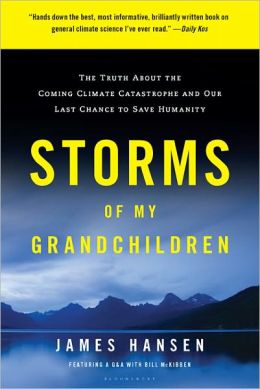
Storms of My Grandchildren by James Hansen.

Henderson: There are many good books for the general reader about the science, the politics, the economics and the psychology of climate change, and it is invidious to single out one or even a few. The Discovery of Global Warming by Spencer Weart, Field Notes from a Catastrophe by Elizabeth Kolbert, Sustainable Energy Without the Hot Air by David McKay, Merchants of Doubt by Naomi Oreskes and Erik Conway, and Eaarth by Bill McKibben are among those worth attention. Greg Craven, a high school science teacher in the US, developed his excellent talks on YouTube into a book called What's the Worst that Can Happen?, and I'd also recommend that.

But if I had to recommend just one book it would be James Hansen's Storms of My Grandchildren because it is, simultaneously, a good introduction to the science, a first-hand account of what it's like to be on the receiving end of attempted sabotage by political operatives who know nothing about the science, and a very human call for action. The book is dedicated to his grandchildren, Sophie and Connor, for whose future he fears in a rapidly warming world.  It also contains a manifesto for  how to address the challenges which, whether or not one agrees with every detail, is as good as any of the necessarily brief outlines you can find in books of this kind.

Hansen, who has just announced that he is stepping down as Director of the NASA Goddard Institute for Space Studies, is a distinguished climate scientist, but one of the things that really marks him out is his passionate commitment to making change happen. Hansen has been unusually outspoken among scientists for a long time. He first came to prominence in 1988, when he testified to the US Senate that he was “99% confident” that the Earth was warming because of human-made greenhouse gases.  He stood up to the administration of George W. Bush when it tried to censor him. And he's put himself on the line, being arrested for demonstrating against mountain top removal mining.  He has been a clear and authoritative voice against the Keystone pipeline, which would bring oil from the highly polluting Athabasca tar sands in Canada to US refineries.  It is precisely because he wants to commit himself full time to activism that he has stood down from his scientific work.

Hansen has been criticised for giving undue stress to the more extreme scenarios within the range of probability if we fail to drastically reduce emissions greenhouse gases. He fears an extinction event comparable to the “great dying” at the end of the Permian period 252 million years ago is a real risk. He's also criticised for being unrealistic in calling for emissions of greenhouse gases to be limited such that atmospheric concentrations do not exceed 350 parts per million – a goal adopted by the campaign group 350.org. These criticisms are worth entertaining but in an unreasonable world, where the functional stupidity of our societies and governments with regard to climate and environment is greater even than the dysfunction embedded in regulation of financial systems before the crash of 2007, a little unreasonableness may be the most reasonable thing.  Hansen has earned the right to speak. We should listen.
Read about the other books Henderson tagged at The Browser.

--Marshal Zeringue

Sunday, April 21, 2013

Five top autobiographical works putatively devoted to other subjects

Sarah Manguso's memoir is The Guardians: An Elegy for a Friend.

One of her five favorite examples of autobiographical writing putatively devoted to other subjects, as told to The Daily Beast:
Monster in a Box by Spalding Gray

Monster is a dramatic monologue, in Gray’s own words “a monologue about a man who can’t write a book about a man who can’t take a vacation.” Plagued by his unfinished 1,800-page novel, the eponymous Monster, Gray seeks to escape it through constant travel. Yet wherever he goes—as it is said—there he is, contained in a Protestant halo of exquisite self-awareness.
Read about the other entries on the list.

--Marshal Zeringue

Saturday, April 20, 2013

Five best books on lovers touching hands

André Aciman is the author of Out of Egypt (1995) and, most recently, Harvard Square, a novel.

One of his five best books on lovers touching hands, as told to the Wall Street Journal:
The Red and the Black
by Stendhal (1830)

The story of a young man's rise in 19th-century Paris would proceed along predictable lines if it weren't layered with Stendhal's piercing genius. He takes Julien Sorel, a naïve carpenter's son from the provinces, and hurls him into a universe of treachery and double-dealing. Torn between the army and the church, Julien, who has no less kindness than gumption in his heart, settles for seduction. One evening he reaches for the hand of his employer's wife. Shocked but unwilling to cause an uproar, she withdraws it. The next evening, he vows to try holding her hand again or else blow his brains out. When they are both sitting out in the garden, he reaches for it, and again she pulls away. Undaunted, he seizes her hand and holds it with "convulsive strength." This is not an amorous pass but a martial siege. Stendhal never says outright that she yields; rather he says something that only the passive voice conveys in English: "A final effort was made to withdraw it, but in the end, this hand remained in his." It turns out the lady was more in love with Julien than he ever dreamed. As for his feelings, the jury is still out.
Read about the other books on the list.

The Red and the Black is among John Banville's five best books on early love and the flush of infatuation, Warren Adler's five best books about ambition, and Norman Mailer's top ten works of literature.

--Marshal Zeringue

Friday, April 19, 2013

Ten picture books that would make great puppet shows

Polly Dunbar is co-founder of the UK-based puppet company Long Nose News. She and Katherine Morton have adapted four picture books into stage shows.

For the Guardian, Dunbar named ten other picture books that would make great puppet shows, including:
In the Night Kitchen by Maurice Sendak

This is a dark and twinkly book, and transports the reader in a theatrical, almost dreamlike way. The kitchen/cityscape evokes a stage set, the menacing bakers have a "Laurel and Hardy" air about them; I like that they might eat Mickey – the boy hero who finds himself in their cookery – at any moment. The whole audience would chant "Milk in the batter, milk in the batter, we bake cake and nothing's the matter" like a spell. Baking smells would waft out over the audience; everybody would be given a freshly-baked cake as they emerged from the dark theatre out in to the daylight. "And that's why thanks to Mickey we have cake every morning."
Read about the other stories on the list.

--Marshal Zeringue

Thursday, April 18, 2013

Ten novels featuring mythical countries

In Partial Disgrace, a novel by the late Charles Newman more than twenty years in the writing, is being published by Dalkey Archive this spring. The book concerns an imaginary Central European nation, Cannonia. Its editor, Ben Ryder Howe, came up with a list of ten novels featuring mythical countries for Publishers Weekly. One entry on the list:
Costaguana

The setting of Nostromo, Joseph Conrad’s acid 1904 political novel about a revolution-torn, resource-cursed country plagued by the meddling of cynical and idealistic Westerners. Since it combines aspects of Colombia, Peru and most of all Panama (none of which Conrad ever visited, interestingly), its location is thought to be somewhere along the coastline of northern South America.
Read about the other mythical countries on the list.

--Marshal Zeringue

Wednesday, April 17, 2013

Ten top book endings

Jessica Soffer earned her MFA at Hunter College. Her work has appeared in Granta, the New York Times, and Vogue, among other publications. She teaches fiction at Connecticut College and lives in New York City.

Her new novel--her debut--is Tomorrow There Will Be Apricots.

For Publishers Weekly Soffer shared ten of her favorite endings in books, including:
Atonement by Ian McEwan

All’s fair in love and postscripts and novel writing about novel writing. Or isn’t it? The jury is still out. McEwan’s novelist narrator gives us a version of things, and then takes that version away when she reveals having imagined the series of events she’s just put forth as true. “WTF,” you might say. Or else, “Really? She (the narrator) can do that? He (McEwan) can do that?” Did it. Done. So whether you feel duped or vindictive or gullible or disappointed, it is certain that McEwan’s ending will make you reconsider the novel’s first 300 pages, how you read them, how you maybe should have, how you trusted the narrator, and how you trust the people you trust. You won’t fall so easily next time, or maybe—in McEwan’s hands—you will.
Read about the other entries on Soffer's list.

Atonement also appears on Jane Ciabattari's list of five masterpieces of fiction that also worked as films, and on John Mullan's lists of ten of the best birthday parties in literature, ten of the best misdirected messages in literature, ten of the best scenes on London Underground, ten of the best breakages in literature, ten of the best weddings in literature, and ten of the best identical twins in fiction. It is one of Stephanie Beacham's six best books.

Visit Jessica Soffer's website.

Writers Read: Jessica Soffer.

My Book, The Movie: Tomorrow There Will Be Apricots.

--Marshal Zeringue

Tuesday, April 16, 2013

Top ten worst sex scenes in modern literature

One title on the Telegraph's list of the ten worst sex scenes in modern literature:
I Am Charlotte Simmons, by Tom Wolfe (2004)

“Slither slither slither slither went the tongue, but the hand that was what she tried to concentrate on, the hand, since it has the entire terrain of her torso to explore and not just the otorhinolaryngological caverns.”
Learn about the other titles on the list.

I Am Charlotte Simmons is on Panayiota Kuvetakis's list of ten of the best wild parties in literature.

--Marshal Zeringue

Monday, April 15, 2013

Five top Hollywood biographies

Carl Rollyson, Professor of Journalism at Baruch College, has published more than forty books ranging in subject matter from biographies of Marilyn Monroe, Lillian Hellman, Martha Gellhorn, Norman Mailer, Rebecca West, Susan Sontag, and Jill Craigie to studies of American culture, genealogy, children’s biography, film, and literary criticism. He has authored more than 500 articles on American and European literature and history. His latest books are Hollywood Enigma: Dana Andrews, a biography of Dana Andrews published in September 2012, and the biography American Isis: The Life and Death of Sylvia Plath, released in January 2013.

One of Rollyson's favorite Hollywood biographies, as told to the Wall Street Journal:
The Unruly Life of Woody Allen
by Marion Meade (2010)

It is hard to pull off an unauthorized biography of a living figure, but Marion Meade does so with aplomb. Her painstaking research results in a concise and penetrating account (originally published in 2000 and recently revised) of Woody Allen's career and working habits. We learn, for example, about the different drafts of his masterpiece, "Annie Hall," which Allen wanted to title "Anhedonia"—until test audiences reacted with "blank stares." The book argues that, after "parading his insecurities, phobias, and deep self-deprecation," the filmmaker came ever closer to his audience, who could see themselves or parts of themselves in this endearing character or, more precisely, in his problems. Meade views "Hannah and Her Sisters" as the best of his achievements, with its beautifully crafted screenplay that shrewdly maintains its focus on character while exploring the heart of family relationships. She doesn't flinch from describing the scandal that erupted when he was discovered in an affair with Mia Farrow's 19-year-old adopted daughter—but this biography concentrates on this distinguished filmmaker's tireless pursuit of his art.
Read about the other books on Rollyson's list.

Visit Carl Rollyson's website, blog, and Facebook page.

The Page 99 Test: American Isis.

My Book, The Movie: American Isis.

The Page 99 Test: Hollywood Enigma: Dana Andrews.

--Marshal Zeringue

Sunday, April 14, 2013

Ten great stories of epic power struggles

At io9, Katharine Trendacosta and Charlie Jane Anders came up with a list of ten great tales of epic power struggles.

One entry on the list:
The Plot Against America by Phillip Roth

Another alt-history novel, Roth's book envisions a world where Charles Lindbergh defeats FDR for re-election and may or may not be a Nazi puppet (but is definitely a Nazi sympathizer). It also features Walter Winchell leading an anti-Lindbergh movement and being assassinated by a possible American Nazi, with KKK help. Then there's a coup by the Vice President and history righting itself at Pearl Harbor. And then there's the German propaganda blaming a Jewish conspiracy for Lindbergh's disappearance and the Lindbergh baby kidnapping -- versus the reigning conspiracy theory that the Nazis were behind everything.
Read about the other entries on the list.

The Plot Against America appears on Steven Amsterdam's list of five top books on worry, Stephen L. Carter's list of five top presidential thrillers, and David Daw's list of five American presidents in alternate history.

--Marshal Zeringue

Saturday, April 13, 2013

Maya Angelou's six favorite books

For The Week magazine, poet and memoirist Maya Angelou named six works that influenced her in her life and career, including:
A Tale of Two Cities by Charles Dickens

Early on, I was so impressed with Charles Dickens. I grew up in the South, in a little village in Arkansas, and the whites in my town were really mean, and rude. Dickens, I could tell, wouldn't be a man who would curse me out and talk to me rudely.
Read about the other books on Angelou's list.

A Tale of Two Cities also appears on Alice-Azania Jarvis's reading list on revolutions, Paulette Jiles's list of her 12 favorite books, and John Mullan's list of ten of the best doppelgängers in fiction.

--Marshal Zeringue

Friday, April 12, 2013

Top ten heroes in disguise

Laura Powell spent most of her childhood with her nose in a book, studied classics at University and then worked at a publishing company. Her books for young adults include the highly acclaimed Burn Mark and its sequel Witch Fire, forthcoming in the US early this summer.

"Heroes have a tendency to hide from the world," Powell writes in the Guardian. "They often have to conceal a secret power or identity; sometimes it's their true nature that's disguised, sometimes just their appearance."

One of Powell's ten favorite heroes in hiding:
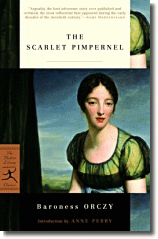
Sir Percy Blakeney in The Scarlet Pimpernel by Baroness Orczy

Sir Percy is the Bruce Wayne of the French Revolution: a rich playboy with a double life spent rescuing people from the guillotine. He's a master of disguise, a dashing swordsman, schemer and escape artist. But to the world at large, he's just another posh nincompoop. Swashbuckle-tastic!
Read about the other entries on the list.

The Scarlet Pimpernel is among Justin Scroggie's top ten books with secret signs and Peter Millar's six top spy books.

--Marshal Zeringue