Friday, September 2, 2022

Seven titles that vividly capture hospitalization

Anna DeForest is an author and physician whose work has appeared in the Alaska Quarterly Review, the Journal of the American Medical Association, the New England Journal of Medicine, and the Paris Review. DeForest has an MFA from Brooklyn College and an MD from Columbia University, and currently works in palliative care at Memorial Sloan Kettering Cancer Center in New York City.

A History of Present Illness is her first novel.

At Electric Lit DeForest tagged seven books that "stretch across genres to capture the confusion and powerlessness of being subject to a body, subject to a hospital, subject to life and death." One title on the list:
The Hospital by Ahmed Bouanani

The Hospital depicts the instant unwinding that comes with protracted illness and confinement. In a delirious dream of time and memory, the narrator, unclearly tubercular, finds himself stuck in a dirty hospital somewhere in the Magreb, his fellow patients all wild men who cling to stories of sex and violence to imitate the vigor of the lives they once led. Set apart from the rhythms of regular life, these men face the degradation and debility of the ailing body—true for us all, but starkly revealed by the enforced humility of medicalization.
Read about the other entries on the list.

--Marshal Zeringue

Thursday, September 1, 2022

Top 10 books about dual identity

Hafsa Zayyan is a writer and dispute resolution lawyer based in London. She won the inaugural #Merky Books New Writers' Prize in 2019.

We Are All Birds of Uganda is her debut novel, inspired by the mixed background from which she hails. She studied Law at the University of Cambridge and holds a masters' degree from the University of Oxford.

At the Guardian Zayyan tagged ten of the best books about dual identity, including:
The Namesake by Jhumpa Lahiri

In her debut novel, Lahiri looks at how our names shape identity, as she tells the story of one American Bengali family and their son, Gogol. Spanning three decades of Gogol’s life in the US, Gogol is constantly pulled between two identities: the Bengali culture of his parents and the American one he is raised in.
Read about the other entries on the list.

The Namesake is among Abir Mukherjee's top ten books about Calcutta, Maura Roosevelt's five juicy, complicated, and otherwise strange family tales, and Amanda Bullock's twelve best dates in fiction.

--Marshal Zeringue

Wednesday, August 31, 2022

Seven of the best locked room mysteries

Alice Feeney is the New York Times bestselling author of Sometimes I Lie, I Know Who You Are, His & Hers, and Rock Paper Scissors. Her novels have been translated into over twenty-five languages, and have been optioned for major screen adaptations.

Feeney was a BBC journalist for fifteen years, and now lives in the Devon countryside with her family. Daisy Darker is her fifth novel.

At CrimeReads the author tagged seven of her favorite locked room mysteries, including:
The Wheel Spins by Ethel Lina White

My second favourite locked room mystery is The Wheel Spins by Ethel Lina White. You may not have heard of this book, or its author, but in her day Ethel was just as popular and successful as Agatha Christie. I think she is an amazing and underrated writer. A lot of people think she may have been forgotten because, like me, she was shy.

The Wheel Spins is about a girl called Iris who is returning to England by train after a somewhat underwhelming holiday. She finds herself in a carriage with a woman called Miss Froy. When Iris wakes up from a nap, Miss Froy is missing and everyone else on the train insists that she was never there in the first place!

I love this book so much, so did Alfred Hitchcock, so he turned it into a film called The Lady Vanishes. (The film is not as good as the book). The Wheel Spins was written in 1936, but it feels surprisingly contemporary when read today. If you enjoy my books I think you might enjoy this too.
Read about the other entries on the list.

--Marshal Zeringue

Tuesday, August 30, 2022

Seven complex portraits of criminality in literature

Our Sister Who Will Not Die: Stories, Rebecca Bernard’s debut collection of stories, won the 2021 Non/Fiction prize from The Journal and was published by Ohio State’s Mad Creek Books in August 2022. Her work has appeared or is forthcoming in Alaska Quarterly Review, Southwest Review, Wigleaf, Witness, and elsewhere. She holds a PhD in Fiction from the University of North Texas and an MFA from Vanderbilt University. Her work received notable mention in the Best American Short Stories of 2018. She is an Assistant Professor in the English department at Angelo State University. She serves as a Fiction Editor for The Boiler.

At Lit Hub Bernard tagged seven of the best complex portraits of criminality in literature, including:
Rachel Kushner, The Mars Room

Kushner weaves a complex, moving, and empathic narrative that challenges our assumptions of criminality and simultaneously exposes the gross inequities within the prison system. The primary first-person point of view follows Romy, a 20-something woman convicted of murdering her stalker as she begins a life sentence within the California prison system. On paper, Romy, a sex worker and a single mother, might elicit a dehumanizing dismissal, but Kushner puts us directly in her shoes, privy to the complex workings of her mind (and importantly, Romy is new to the system alongside the reader). The real magic in Kushner’s narrative comes through the bold offering of multiple close-third person viewpoints alongside Romy that include an incarcerated former policeman, one of Romy’s peers in prison, Sammy, and the teacher of the prison GED program. With each perspective, we see more deeply into the character’s actions, both their capacity to hurt others, as well as their methods for survival in a society and system that rarely protects its most disenfranchised members from the gross and far-reaching effects of poverty and abuse. Daring in its empathic reach, this book enforces the idea that no individual holds all parts of a story, and we’re better for the humility that awareness brings.
Read about the other entries on the list.

--Marshal Zeringue

Monday, August 29, 2022

Ten of the best books highlighting honesty

Reviewers at the Christian Science Monitor tagged ten books that "offer powerful examples of people seeking truth, pursuing justice, and insisting on the dignity of each individual." One title on the list:
The Inheritors by Eve Fairbanks

The end of South Africa’s apartheid regime in 1994 was met with jubilation. But the new government faced daunting challenges, and whatever its successes, it was bound to disappoint. Decades later, journalist Eve Fairbanks gets to know South Africans who grew up under apartheid and those who don’t remember it. The result is a moving group portrait of disillusion and resilience.
Read about the other entries on the list.

--Marshal Zeringue
Sunday, August 28, 2022

Eleven top books about restaurant kitchens

At Vulture Megan Hennessey tagged eleven books "if you .. want to immerse yourself in the thrilling (and oftentimes stressful) world of restaurants, or if you just need a cathartic story centered on a kitchen." One title on the list:
I Hear She’s a Real Bitch, by Jen Agg

Jen Agg, author of I Hear She’s a Real Bitch and owner of several restaurants in Toronto, doesn’t want to play by the rules created and maintained by chef bros, her term for the dudes who insist on running their kitchens with a perfectionistic, overbearing attitude. So she created her own path forward, opening her own restaurant called the Black Hoof. As the owner, she challenges the Way Things Are Done™. Why should the back of house and front of house always be feuding? Why should she have to prove single-handedly, usually without proper support, that she can beat a system determined to crush her? This book is full of anecdotes, tips for building your own restaurant, and strong opinions about cocktails.
Read about the other entries on the list.

--Marshal Zeringue

Saturday, August 27, 2022

Five of the best road trip novels featuring women

Before her retirement in 2014, Deborah K. Shepherd was the director of a domestic violence program in central Maine. Her essays have been published by Herstry, Persimmon Tree, Women on Writing, and Women Writers, Women’s Books. Her Covid-themed essay was a winner in the Center for Interfaith Relations 2020 Sacred Essay Contest. During an earlier career as a reporter, she wrote for Show Business Newspaper and the Roe Jan Independent, a weekly newspaper in upstate New York. She holds a BFA in drama from the University of Arizona and an MSW from Fordham University.

Shepherd's first novel is So Happy Together.

At Shepherd she tagged five of the "best road trip novels with women in the driver’s seat," including:
Boop and Eve's Road Trip by Mary Helen Sheriff

The author had me at the first line: “Boop loved her daughter to the moon and back, but Justine had a way of sucking the joy out of a room faster than a vampire bat.” This road trip story about three generations of women (Boop, her daughter, Justine—who’s not in the car, but her presence is—and Justine’s daughter, Eve) set against a background of family secrets, has a decidedly Southern tone. One imagines a narrator relating the story from a rocker on the front porch, a glass of sweet tea in her hand. Although there are lighthearted moments, this is a serious story, about familial expectations, mental illness, family secrets, estrangement, and three women trying to find their way back to themselves and to each other. Travelling with this unforgettable grandmother/granddaughter duo is a gift.
Read about the other entries on the list.

--Marshal Zeringue

Friday, August 26, 2022

Five SFF books about the multiverse

Tim Pratt is a Hugo Award-winning SF and fantasy author, and has been a finalist for World Fantasy, Sturgeon, Stoker, Mythopoeic, and Nebula Awards, among others. He is the author of over twenty novels, including The Deep Woods and Heirs of Grace, and scores of short stories. His work has been reprinted in The Best American Short Stories, The Year's Best Fantasy, The Mammoth Book of Best New Horror, and other nice places. Since 2001 he has worked for Locus, the magazine of the science fiction and fantasy field, where he currently serves as senior editor. He lives in Berkeley, CA with his wife and son.

Pratt's latest novel is Prison of Sleep: Book II of the Journals of Zaxony Delatree.

[Writers Read: Tim Pratt (October 2019); Writers Read: Tim Pratt (April 2022)]

At Tor.com the author tagged five "books and stories that got me hooked on the concept of the multiverse in the first place, and the ones that expanded my idea of what multiverse stories could accomplish," including:
The Talisman by Stephen King and Peter Straub

Twelve-year-old Jack Sawyer’s mother is dying of cancer in a crumbling East Coast hotel when Jack meets a strange old man at an amusement park. The man tells him there’s a way to save her life: go on a quest across the country, and across realities, to obtain the Talisman. During the course of his journey, Jack has to “flip” back and forth between the long roads of the United States and a parallel universe, The Territories, a magical version of North America populated by monsters, mutants, wolf-people, and “twinners” of some people in our reality—his mother, for instance, is a queen over there, and she’s dying, too. This is a long, weird, occasionally heartwarming (but mostly heart-wrenching) coming-of-age story, as Jack proceeds along the “road of trials,” making allies and enemies along the way. The most mind-blowing part comes at the very end, when Jack begins to flip rapidly through alternate realities, revealing that our world and the Territories are just two of a possibly infinite number of possible realities. (King went on to explore that idea alone in his multiverse epic Dark Tower series.)
Read about the other entries on the list.

--Marshal Zeringue

Thursday, August 25, 2022

Top 10 books about Israel

Lavie Tidhar was born just ten miles from Armageddon and grew up on a kibbutz in northern Israel. He has since made his home in London. He won the Jerwood Fiction Uncovered Prize for Best British Fiction, was twice longlisted for the International Dublin Literary Award and was shortlisted for the CWA Dagger Award and the Rome Prize. He co-wrote Art and War: Poetry, Pulp and Politics in Israeli Fiction, and is a columnist for the Washington Post.

Tidhar's latest work is Maror, "a novel that attempts to write an Israel that couldn’t be written from within."

At the Guardian he tagged ten books that answer the question How does one write of Israel? differently. One title on the list:
One Mile and Two Days Before Sunset by Shimon Adaf

Adaf’s first novel is merely the opening shot in the recently translated Lost Detective trilogy, which treats the story of Israel as a fiction that must be deciphered by an author-detective lost in the futility of the attempt. A welcome introduction in English to one of Israel’s most adventurous literary novelists.
Read about the other entries on the list.

--Marshal Zeringue

Wednesday, August 24, 2022

Ten essential Illinois books

Edward McClelland is a native of Lansing, Mich., which is also the birthplace of Burt Reynolds and the Oldsmobile.

McClelland’s most recent book, Midnight in Vehicle City: General Motors, Flint, and the Strike That Built the Middle Class, is a narrative account of the 1936-37 Flint Sit Down Strike, which led to the establishment of the United Auto Workers as the nation’s flagship labor union. His previous book, How to Speak Midwestern, is a guide to the speech and sayings of Middle America, which The New York Times called “a dictionary wrapped in some serious dialectology inside a gift book trailing a serious whiff of Relevance.”

At Chicago magazine McClelland tagged ten books to take us on "an armchair journey through Illinois, from Chicago to Cairo, and from the Age of Lincoln to the Age of Obama," including:
A Street in Bronzeville, Gwendolyn Brooks

There may be more widely read Chicago authors than Gwendolyn Brooks, but there has never been one more beloved. “Miss Brooks,” as the poetess was known (although she was married to Henry Blakely for 57 years) succeeded the Olympian Carl Sandburg as Illinois Poet Laureate. Brooks’s first collection, A Street in Bronzeville, offered a more commonplace look at Black Belt life than Wright’s drama. The lead-off poem is titled “kitchenette building”: “‘Dream’ makes a giddy sound, not strong/ Like “rent,” “feeding a wife,” “satisfying a man.” Brooks was an inspiration to the city’s rappers, and even in this early work, Brooks’s verses contain the seeds of hip-hop, as when she writes about “the soft man”: “Disgusting, isn’t it, dealing out the damns/ To every comer? Hits the heart like pain./ And calling women (Marys) chicks and broads/ Men hep, and cats, or corny to the jive.”

Five years later, Brooks became the first African-American to win a Pulitzer Prize, for Annie Allen. A statue of Brooks was recently unveiled in a Kenwood park that bears her name.
Read about the other entries on the list.

--Marshal Zeringue

Tuesday, August 23, 2022

Ten of the best books about how people imagine politics

Eve Fairbanks writes about change: in cities, countries, landscapes, morals, values, and our ideas of ourselves. A former political writer for The New Republic, her essays and reportage have been published in The Washington Post, The New York Times, and The Guardian, among other outlets. Born in Virginia, she now lives in Johannesburg, South Africa.

The Inheritors: An Intimate Portrait of South Africa's Racial Reckoning is her debut.

At Lit Hub Fairbanks tagged ten favorite titles "about politics [that] dig deep into how people imagine politics—how we imagine what makes people happy and how much change we can tolerate to our self-image." One entry on the list:
Moises Naim, The End of Power: From Boardrooms to Battlefields and Churches to States, Why Being in Charge Isn’t What It Used to Be

Paradoxically, imagining that maximally evil, conspiratorial, even psychopathic political villains—Soros, the Koch brothers—control our world can be a comfort, a purportedly dark worldview that belies a hidden optimism. If a small set of villains wield outsized power, it would be possible to right the world by ousting them. Naim has worked and traveled among favorite villains of the left and the right as head of Foreign Policy magazine and the World Bank’s executive director. And he does something virtually no other writer dares to do: really depict the world from the point of view of the Davos elites everybody likes to make out as evil geniuses. In Naim’s telling, they also feel impotent, even terrified—a persuasive argument that upends many myths of contemporary politics. I probably recommend this book to others more than any other work of contemporary political nonfiction.
Read about the other titles on the list.

--Marshal Zeringue

Monday, August 22, 2022

Seven YA titles that bring color to dark academia

Nzinga Temu is a writer who received her Bachelor of Arts degree in English from Howard University. During her undergraduate studies she has written for Zenger News and Picture This Post.

At Electric Lit she tagged, "for all of the academics of color, ... a list of seven dark YA narratives surrounding the intrigues of academic life." One title on the list:
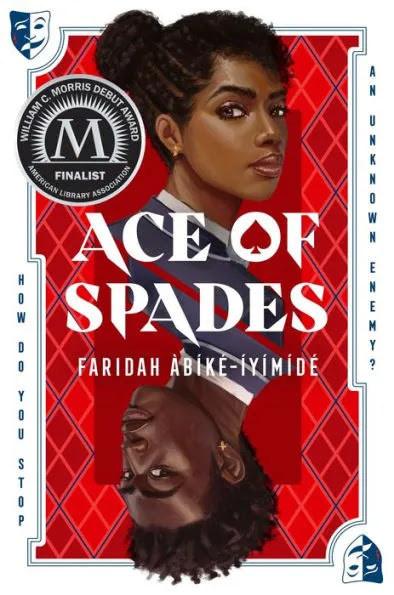
Ace of Spades by Faridah Àbíké‑Íyímídé

Feeling like the fly in the buttermilk is an all too familiar sensation to African American academics, and Faridah Àbíké-Íyímídé’s debut novel fuses the air of petty evil from Pretty Little Liars with the anxiety of being cornered from Get Out to articulate this experience. Elite, wealthy, popular girl Chiamaka, and unsociable yet talented musician from the rough part of the neighborhood, Devon are the only two Black students at Niveus Private Academy. They both have high aspirations that all hinge on the success of their final year of high school, but during the first weeks of class they are sabotaged by anonymous text messages sent to their classmates that spill secrets that can ruin their lives, or have them dead.

Àbíké‑Íyímídé addresses systemic racism in academia as well as toxic friendships, all the while drawing us in with the drama and intrigue. As a Black, queer author, she is as tired of Black and queer struggle narratives as the rest of us; we can count on her to not put us through any unnecessary pain. But Ace of Spades is certainly a thriller, and challenges two Black high schoolers to survive the racist tyranny of their white classmates all while maintaining their prestigious college prospects.
Read about the other entries on the list.

--Marshal Zeringue