Sunday, March 11, 2012

Ten of the best fossils in literature

At the Guardian, John Mullan named ten of the best fossils in literature.

One novel on the list:
Oscar and Lucinda by Peter Carey

The first part of this novel draws on Gosse's Father and Son, depicting Oscar and his father Theophilus as members of a fundamentalist sect in Devon, and also devoted naturalists. Oscar's father collects and classifies fossils, determined to use them to disprove the Darwinian account of evolution. He thinks God has put fossils into the rocks to show his own power.
Read about the other entries on the list.

Oscar and Lucinda also appears on Mullan's lists of ten of the best thin men in literature and ten of the best card games in literature, the Guardian's list of ten of the best unconsummated passions in fiction, and Elise Valmorbida's top ten list of books on the migrant experience.

--Marshal Zeringue

Saturday, March 10, 2012

Kathryn Harrison's 6 favorite books with parentless protagonists

Kathryn Harrison's latest novel is Enchantments.

One of her six favorite books with parentless protagonists, as told to The Week magazine:
Jane Eyre by Charlotte Brontë

A plucky orphan determined to find the love her childhood lacked, a brooding Byronic suitor, a mad woman locked in an attic, dark secrets, vengeance, just desserts: This is a Gothic romance with a feminist twist. Jane may not be beautiful or wellborn, but she stands in the company of literature's greatest heroines.
Read about the other entries on the list.

Jane Eyre also made Megan Abbott's top ten list of novels of teenage friendship, a list of Bettany Hughes's six best books, the Guardian's top 10 lists of "outsider books" and "romantic fiction;" it appears on Lorraine Kelly's six best books list, Esther Freud's top ten list of love stories, and Jessica Duchen's top ten list of literary Gypsies, and on John Mullan's lists of ten of the best governesses in literature, ten of the best men dressed as women, ten of the best weddings in literature, ten of the best locked rooms in literature, ten of the best pianos in literature, ten of the best breakfasts in literature, ten of the best smokes in fiction, and ten of the best cases of blindness in literature. It is one of Kate Kellaway's ten best love stories in fiction.

The Page 99 Test: Jane Eyre.

--Marshal Zeringue

Friday, March 9, 2012

Five of the best books on trust

Bruce Schneier is an internationally renowned security technologist who studies the human side of security. A prolific author, he has written hundreds of articles, essays, and academic papers, as well as eleven books that together have sold more than 400,000 copies. He has testified before Congress, is a frequent guest on television and radio, and is regularly quoted in the press.

His new book is Liars and Outliers: Enabling the Trust that Society Needs to Thrive.

He discussed five books on trust with Alec Ash at The Browser, including:
Braintrust
by Patricia S Churchland

Braintrust, by the neuroscientist Patricia Churchland. This book is about the neuroscience of morality. It's brand new – published in 2011 – which is good because this is a brand new field of science, and new discoveries are happening all the time. Morality is the most basic of societal pressures, and Churchland explains how it works.

This book tries to understand the neuroscience behind trust and trustworthiness. In her own words:

“The hypothesis on offer is that what we humans call ethics or morality is a four dimensional scheme for social behavior that is shaped by interlocking brain processes: (1) caring (rooted in attachment to kin and kith and care for their well-being), (2) recognition of other’s psychological states (rooted in the benefits of predicting the behavior of others) (3) problem-solving in a social context (e.g., how we should distribute scarce goods, settle land disputes; how we should punish the miscreants) and (4) learning social practices (by positive and negative reinforcement, by imitation, by trial and error, by various kinds of conditioning, and by analogy).”

Those are our innate human societal pressures. They are the security systems that keep us mostly trustworthy most of the time – enough for most of us to be trusting enough for society to survive.
Read about the other books on the list at The Browser.

The Page 99 Test: Patricia Churchland's Braintrust.

The Page 99 Test: Bruce Schneier's Liars and Outliers.

--Marshal Zeringue

Thursday, March 8, 2012

Top ten weird histories

Lloyd Shepherd's first novel, The English Monster, is published by Simon and Schuster in the UK on March 1 2012, and by Washington Square Press in the US in May.

For the Guardian, he came up with a top ten list of weird histories, books that follow from the central idea "that history is a fantasy which can be reestablished by the author - and takes it in all sorts of directions." One title on his list:
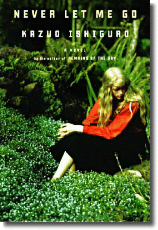
Never Let Me Go by Kazuo Ishiguro

Kazuo Ishiguro is the master of small things beautifully described, and in Never Let Me Go he takes a well-established archetype - a boarding school in the English countryside - and slowly subverts it. His characters live in a world which is quintessentially English and yet somehow exquisitely different. The location of this difference gradually becomes apparent, and allows Ishiguro to ask a simple question: what would a world look like in which a major biological breakthrough had happened in the recent past? His world is one reeling from an ethical explosion which works its way out, beautifully and very, very sadly.
Read about the other entries on the list.

Never Let Me Go is on John Mullan's list of ten of the best sentences as titles.

--Marshal Zeringue

Wednesday, March 7, 2012

Five notable memoirs of Communism

A columnist for the Washington Post, Anne Applebaum is the author of Gulag: A History, an acclaimed historical account of the Soviet concentration camp system that won the 2004 Pulitzer Prize for General Nonfiction.

One of the five top memoirs of Communism she discussed with Alec Ash at The Browser:
The Captive Mind by Czeslaw Milosz

Tell us about Miłosz’s book The Captive Mind, to begin with.

The Captive Mind isn’t a straight memoir. Although Milosz is writing about his own life and his past, he is also grappling with a larger subject: How his generation of liberal intellectuals came to collaborate with, and work alongside, the Communist party. And he is trying to understand his own behaviour: Why did I act that way?

To explain, he uses an extended metaphor: “It’s as if we all took a magic pill, became temporarily enchanted and went along with this ridiculous thing.” Then he goes through some “case studies” of individuals’ behaviour – even though they’re not named in the book, we know who he was writing about – and tries to explain why people collaborated or opposed the regime. In essence, the book is about the mentality of collaboration with communism.

In a nutshell, what is that mentality? Why did people go along with it?

He gives a lot of reasons. He explains the shattering effect of the war in that part of the world, where the fighting was far more brutal than anything in Western Europe. Between 1939 and 1945, it was normal, in Warsaw, to see a corpse lying in the street. Moral norms were shattered, as all sorts of illegal activity became normal too. Good people robbed banks and planted bombs, on behalf of the Underground.

After the war, many people felt they couldn’t just go back to the way things were before. They couldn’t just reconstruct 1920s or 1930s Poland, many felt: everything has been changed by this war and we need to start from scratch. Miłosz also talks about people who wanted their books published or their careers advance, people who collaborated in order to get ahead and join the new literary establishment.

He is important to read because he’s simultaneously critical of his characters and sympathetic to them. It’s very difficult, now, to think back into that time, when people had very limited choices. If you chose to oppose the regime, that might mean you couldn’t get medicine for your sick mother, your children couldn’t go to school and you might get kicked out of your apartment. We don’t have to face those choices. Miłosz is very good at explaining them.
Read about the other books Applebaum tagged at The Browser.

--Marshal Zeringue

Tuesday, March 6, 2012

Five best books about mothers of many sorts

Elizabeth Lowry has worked as an editor of the Oxford English Dictionary and as the deputy headmistress of a girls’ school. She contributes frequently to the London Review of Books and The Times Literary Supplement, and has also written for Harper’s Magazine and Granta.

Her debut novel is The Bellini Madonna.

For the Wall Street Journal, she named a five best list of books about mothers of many sorts. including:
The Fifth Child
by Doris Lessing (1988)

Maternal love is tested to its limit in Doris Lessing's tough fable about suburban parenthood gone wrong. Harriet and David Lovatt create an Edenic family home for their growing brood of children, but their idyll is disrupted by the birth of Ben, the Lovatts' fifth child. Violently active in the womb, troll-like and viciously antisocial once born, Ben is "absolutely not ordinary," the result of "a chance gene" afloat in the human matrix. He strangles the family dog and terrorizes his siblings, who fear for their lives. David presses Harriet to institutionalize Ben, and when she refuses, the family collapses: The other children choose to live with relatives, and David avoids the house, leaving Harriet alone with her increasingly feral son. This chill book concludes with Harriet unable to abandon Ben yet hoping that he will simply drift away, freeing her to move on. Not so much a case of maternal love, then, as of maternal endurance.
Read about the other books on the list.

--Marshal Zeingue

Monday, March 5, 2012

Top ten villains in children's books

Derek Landy spends his time complaining about blogs and writing the Skulduggery Pleasant series- which includes Skulduggery Pleasant, known as Scepter of the Ancients in the US, Playing With Fire, The Faceless Ones, Dark Days and Mortal Coil. He doesn’t like to brag about all the awards he’s won, such as the Irish Book of the Decade, or the Red House in the UK, or all the other awards that he humbly displays on his mantelpiece. He is also far too modest to mention things like the first book being a Publishers Weekly Best Book of the Year and a selection of Oprah’s Book Club Kids Reading List.

For the Guardian, he named a top ten list of "the most dastardly and devious villains in children's books," including:
Sauron (The Lord of the Rings by JRR Tolkien)

I'm not entirely sure that The Lord of the Rings could be classed as children's literature, but The Hobbit certainly was, so Sauron gets his place. You all know him by now. Big guy. Wears armour. Turned into an eye. The Monocled One lusts after power for power's sake, and will crush anyone and anything who stands in his way. There's a whole lot of allegory going on here that impresses people who like allegories, but I just like the crushing bits.
Read about the other villains on the list.

The Lord of the Rings also made Charlie Jane Anders and Michael Ann Dobbs' list of ten classic SF books that were originally considered failures, Lev Grossman's list of the six greatest fantasy books of all time, and appears on John Mullan's lists of ten of the best women dressed as men, ten of the best bows and arrows in literature, ten of the best beards in literature, ten of the best towers in literature, ten of the best volcanoes in literature, ten of the best chases in literature, and ten of the best monsters in literature. It is one of Salman Rushdie's five best fantasy novels for all ages. It is a book that made a difference to Pat Conroy.

The Hobbit is a book Niall Ferguson hopes parents will read to their kids. It appears on John Mullan's list of ten of the best riddles in literature.

--Marshal Zeringue

Sunday, March 4, 2012

Five best books on failed presidential candidates

Scott Farris is the author of Almost President: The Men Who Lost the Race But Changed the Nation.

For the Wall Street Journal, he named a five best books list on candidates whose White House bids failed but whose stories have much to tell us about politics and ambition. One title on the list:
The Liberals' Moment
by Bruce Miroff (2007)

Modern conservatives still mark Goldwater's landslide loss in 1964 as the birth of their movement. Bruce Miroff's penetrating study shows that today's Democrats ought to feel the same way about George McGovern's similarly overwhelming defeat of 1972. Yet Democrats regard McGovern's campaign less as the birth of something new than as the death of something dear. McGovern saw that the old New Deal coalition of urban ethnic groups, organized labor and Southern white populists was fading, and so he created a "new politics" coalition focused on minorities, women, the young and educated issue activists—the same coalition that Barack Obama rode to victory in 2008. McGovern also changed the way we choose our presidents by opening up the process by which national convention delegates are selected. Republicans, too, have adopted this democratized process, generally replacing winner-take-all primaries with proportional delegate allocation that benefits insurgent campaigns. If the 2012 Republican nomination remains unsettled for months, it will be partly due to the legacy of a liberal Democratic nominee.
Read about the other books on the list.

--Marshal Zeringue

Saturday, March 3, 2012

Ramin Karimloo's six favorite books

Ramin Karimloo is the musical star best known as the Phantom in The Phantom of The Opera and its sequel Love Never Dies.

One of his six favorite books, as told to the Daily Express:
THE ROAD
by Cormac McCarthy

I just loved the relationship between father and son and what the dad was trying to teach the boy on this post-apocalyptic journey.

I love slow-burners and this book takes time to get to know the characters, you become invested in their lives.
Read about the other books on Karimloo's list.

The Road appears on Jon Krakauer's five best list of books about mortality and existential angst, William Skidelsky's list of the top ten most vivid accounts of being marooned in literature, Liz Jensen's top 10 list of environmental disaster stories, the Guardian's list of books to change the climate, David Nicholls' top ten list of literary tear jerkers, and the Times (of London) list of the 100 best books of the decade. Sam Anderson of New York magazine claims "that we'll still be talking about [The Road] in ten years."

--Marshal Zeringue

Top ten angel books

Karl O. Knausgaard was born in Norway in 1968 and is the author of Out of This World (Ute av verden) and A Time for Everything, which was nominated for the Nordic Council Prize. The first volume of his Min Kamp (My Struggle) was the winner of Norway's 2009 Brage Prize.

In 2008 at the Guardian, he named his top ten angel books. One entry on the list:
The Divine Comedy by Dante

Even though no author has given a richer and more complex picture of the angels in heaven than Dante, it is of course his fallen ones that are most memorable. The angels are connected with light and movement - everything in heaven is moving - in contrast to hell, where each circle restricts movement further. At the bottom of the universe, Lucifer himself reigns over a frozen lake. Hell is immobility, and in the intensity and concentration of this evil, where only the heads of the sinners are above the ice, heaven seems endlessly remote. Which it is.
Read about the other entries on the list.

Inferno appears on Jon McGregor's list of the top 10 dead bodies in literature, John Mullan's list of ten of the best visions of hell in literature, and Peter Stanford's list of the ten best devils in film and literature; The Divine Comedy is one of George Weigel's five essential books for understanding Christianity.

Also see: Ten of the best angels in literature.

--Marshal Zeringue

Friday, March 2, 2012

Tom McCarthy's six favorite books about nothing

Tom McCarthy is the author of Remainder, C, and Men in Space, the last of which has just been published in the U.S.

One of his six favorite books about nothing, as told to The Week magazine:
Ulysses by James Joyce

A man buys offal for his breakfast, visits a newspaper office, a restaurant, a brothel; another man paces a beach; a woman gets her period; a scrap of paper floats downriver. And at the same time, Odysseus is reunited with Penelope, all of history is compressed into a single day, and Western literature surges toward its apotheosis.
Read about the other books on the list.

Ulysses is on Alice-Azania Jarvis's reading list on grammar, George Vecsey's list of six favorite books, Nina MacLaughlin's top ten list of dirty old (literary) men, John Mullan's lists of the ten of the best parodies, ten of the best Hamlets in literature, ten of the best visits to the lavatory, and ten of the best vegetables in literature. It appears on Frank Delaney's top ten list of Irish novels and five best list of books about Ireland.

Also see Tom McCarthy's top 10 European modernists and Tom McCarthy's literary top 10.

--Marshal Zeringue

Thursday, March 1, 2012

Top ten comic tragedies

Shalom Auslander was raised as an Orthodox Jew in Spring Valley, New York. Nominated for the Koret Award for writers under thirty-five, he has published stories and articles in Esquire, The New Yorker, and the New York Times Magazine, as well as on nerve.com and nextbook.org. He is a regular contributor to PRI’s “This American Life.” His first book, the short story collection Beware of God, was published to critical acclaim in 2005. Auslander's new novel is Hope: A Tragedy.

One of his top ten comic tragedies, as told to the Guardian:
Candide by Voltaire

A young couple dreaming of an idyllic future get chased from their home into a dark, forbidding, well, planet: everything sucks, everywhere. They are separated from each other, beaten, robbed, raped. There are wars, conflicts, disasters of every kind, and by the time the once-happy couple reunites at the end, his naive optimism is all but gone, and she is but a haggard, broken shadow of her former self. The End. Hilarious.
Read about the other books on the list.

Candide is a book Rolling Stone political columnist Matt Taibbi reads every couple of years. It is on John Mullan's list of ten of the best visits to Venice in literature and Dan Rhodes's top 10 list of short books.

--Marshal Zeringue