Saturday, April 14, 2012

Six top books about science and tech

Jon Gertner grew up in Berkeley Heights, New Jersey—just a few hundred yards away from Bell Labs. He has been a writer for the New York Times Magazine since 2004 and is currently an editor at Fast Company magazine.

His new book is The Idea Factory: Bell Labs and the Great Age of American Innovation.

One of Gertner's six favorite books about science and technology, as told to The Week magazine:
Collapse by Jared Diamond

Mayan culture, Easter Island, the Soviet Union. Diamond ranges far and wide across global history in this profoundly sobering book about what happens when societies enter periods of rapid decline — and how some have averted disaster by making wise choices.
Read about the other books on the list.

Collapse appears on a list of nine books Bill Gates thinks you should read, Andrew Ellson's critic's chart of "cash crashes", and the Guardian's list of the best books on global warming.

Gertner's The Idea Factory is one of the Barnes & Noble Review's five top books on innovation.

--Marshal Zeringue

Friday, April 13, 2012

Robson Green's six best books

Robson Green is best known in the U.S. for his portrayal of Dr. Tony Hill in the television series Wire In The Blood.

One of his six favorite books, as told to the Daily Express:
Animal Farm
by George Orwell

I loved this as a child and the character Boxer really reminds me of the life my dad had.

He worked down the mines for 40 years and was in essence a slave to those in power, the same as Boxer. It resonates with my father’s demise.

Animal Farm was my first insight into politics as a child, that the pursuit of power will always end in corruption.
Read about the other books on Green's list.

Animal Farm is one of Heather Brooke's five books on holding power to account, Chuck Klosterman's most important books; it appears on John Mullan's list of ten of the best pigs in literature and Charlie Jane Anders and Michael Ann Dobbs's list of well-known and beloved science fiction and fantasy novels that were rejected over and over.

--Marshal Zeringue

The ten best Shakespeare characters

For the Guardian, Robert McCrum came up with a list of the ten best Shakespeare characters, including:
Lear: King Lear

Hamlet is the young actor’s supreme test, but Lear is the one part to which every leading man aspires. The British stage has seen recent landmark performances from Ian McKellen and Derek Jacobi, for my money the greatest Lear of his generation. Madness, bloodshed and stage nudity: it’s a physically daunting role, occupying 22% of the script (Hamlet accounts for a massive 37%). In Act III, Scene I, the storm (“Blow winds, and crack your cheeks”) leads to one of the most extraordinary moments of western theatre – a high point in a play rich in astounding scenes. Shakespeare’s vision of humanity is bleak but strangely uplifting
Read about the other characters on the list.

King Lear is among the top twenty works of literature according to the contributors to The Top Ten: Writers Pick their Favourite Books. It appears on Gillian Orr's reading list on fatherhood.

--Marshal Zeringue

Thursday, April 12, 2012

Top ten philosophers' novels

Seán McGrady was raised in Belfast, immersed in the religious and political ideas that defined the Irish Troubles. A former university lecturer in philosophy, he lives in York, England. His latest novel is The Backslider.

"The philosophical novel is the continuation of philosophical reflection by other means," he wrote in the Guardian. "To do justice to the nature of ontological concepts, Plato required a mythological approach in order to illuminate the distinction between essences and existence, which resisted conceptualisation. To do justice to the totality of human experience, existentialism denied objectifying knowledge. Justice was eminently done in some cases, their place in history of philosophical ideas assured and their literary merit lauded. Others failed to hit their desired target but were nonetheless notable for daring to articulate the philosophical idea in this form, and being popularly successful, if not philosophically original."

One of McGrady's top ten philosophers' novels:
Candide by Voltaire

Candide is perversion. Voltaire the perverter. Ill-informed about profound religious ideas, he proceeds with caricature. In the history of ideas, that line of "common sense philosophy" leads straight from Voltaire to the modern preachers and prophets of this perversion. Dawkins is an heir of Voltaire. In the name of enlightenment the Frenchman concocts a literary argument against an enlightened metaphysics. Here literature is cowardly. It is journalistic. The enemy of truth that Plato saw in certain literary forms. Voltaire failed to understand rationalist metaphysics and so gave to the world a distortion. The curse of "common sense".
Read about the other novels on the list.

Candide is a book Rolling Stone political columnist Matt Taibbi reads every couple of years. It is on Shalom Auslander's top ten list of comic tragedies, John Mullan's list of ten of the best visits to Venice in literature and Dan Rhodes's top 10 list of short books.

--Marshal Zeringue

Wednesday, April 11, 2012

Five of the best books about animals

Delia Ephron, author and screenwriter, has written many books for children and adults, including the recently released The Lion is In.

One of her five best books on animals, as told to the Wall Street Journal:
Merle's Door
by Ted Kerasote (2007)

In a dog owner's memoir, the dog usually dies. That's the thing about dogs. We love them and lose them—they go through the life cycle on fast-forward, loving and adorable at every stage, even as teenagers. When I'm reading one of these books, I always know I'm headed for a gigantic sobfest. "Merle's Door," no exception, is the story of a Labrador/golden retriever/hound mix that Ted Kerasote finds on a river-rafting trip. Kerasote, an outdoorsman and nature writer, names the dog Merle and takes him home to Kelly, Wyo., a village of 90 or so people whose collective backyard is the Grand Teton National Park. Merle becomes his own boss, as much as a dog can, going and coming at will. If your dog has only walked on cement and frolicked in a dog park—and never tumbled down a snowy mountain, braved rapids, tangled with an elk or outsmarted a coyote—you may find this book the most romantic possible account of someone else's life with a dog. Kerasote weaves into his narrative all sorts of behavioral, historic and scientific facts about dogs. You can skip those sections or not, the way you can read simply the peace parts of "War and Peace." For a time in the memoir, Kerasote has a girlfriend and Merle finds happiness with a female pooch, but the love of their lives is clearly each other.
Read about the other books on Ephron's list.

The Page 69 Test: Merle's Door.

--Marshal Zeringue

Tuesday, April 10, 2012

Six notable stories of addiction

Dan Barden is the author of the novels John Wayne and The Next Right Thing.

A native of Southern California, he teaches at Butler University, and lives in Indianapolis, Indiana, with his wife, Elizabeth Barden, owner of Indianapolis’s Big Hat Books.

One of his six favorite stories of addiction, as told to The Week magazine:
Jamesland by Michelle Huneven

A novel about a group of friends who are growing, together, in hipster Los Angeles. The issues here are so completely the issues of recovery: how to live in community, how to love unselfishly, how to find your right livelihood. As one character keeps asking himself, "How do people live in this world?" Huneven's book even features the ghost of William James, the godfather of the recovery movement.
Read about the other entries on the list.

--Marshal Zeringue

Monday, April 9, 2012

Ten of the best emperors in literature

At the Guardian, John Mullan named ten of the best emperors in literature.

One entry on the list:
Robert Graves's Claudius

Graves gives us a gallery of emperors: wise Augustus, who is a fool when it comes to the scheming of his own wife, Livia; corrupt and sensual Tiberius; bonkers Caligula. The ruling presence is the narrator, stammering Claudius, saved from being murdered by the fact that he seems a dolt. In the end, he too will be laid low by the woman he loves.
Read about the other emperors on the list.

I, Claudius also appears on Andrew Miller's top ten list of historical novels, Mark Malloch-Brown's list of his six favorite novels of empire, Annabel Lyon's top ten list of books on the ancient world, Lindsey Davis' top ten list of Roman books, and John Mullan's list of ten of the best poisonings in literature.

--Marshal Zeringue

Sunday, April 8, 2012

Thirteen of the best baseball books

Jimmy So is Deputy Books Editor at Newsweek/The Daily Beast.

One of his thirteen best baseball books:
The Natural by Bernard Malamud

The most divisive book on this list isn’t so much a baseball novel as it is a novel by a man who didn’t consider a book to be a book unless it can be used to procure a Pulitzer. There’s something about baseball that mesmerized post-war immigrants, and Malamud nailed it with the mythical tale of Roy Hobbs, a “natural” of such star magnetism that he gets shot by a woman for mysterious reasons, and then must climb out of the recovery abyss. One swing of his bat (the Excalibur-like “Wonderboy”) could mean redemption—or ruin. Baseball purists find this allegory dark and over-the-top. But Malamud, who didn’t let so much as a fly buzz by without writing about it as long as it passed through Brooklyn, showed us what Jews living blocks away from Ebbets Field must have felt: awe and hope in the shadow of an ugly new world.
Read about the other baseball books So tagged at The Daily Beast.

Also see Will Dean's list of five books on baseball, Allen Barra's five best works of fiction about baseball, Marjorie Kehe's ten best list of baseball books, Doug Glanville's best books on baseball, Richard J. Tofel's list of the five best books on baseball as a business, Tom Werner's six favorite baseball books, Fay Vincent's five best list of baseball books, Tim McCarver's five best list of baseball books, and Nicholas Dawidoff's five best list of baseball novels.

--Marshal Zeringue

Saturday, April 7, 2012

Five notable books on castaways

One title on the Barnes & Noble Review's list of five top books on castaways:
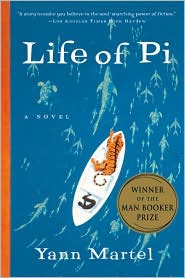
Life of Pi
by Yann Martel

Heard the one about a 16-year-old zookeeper's son who finds himself adrift on a lifeboat in the Atlantic Ocean with a hyena, an orangutan, a wounded zebra, and Richard Parker, a 450-pound Bengal tiger? As his fellow shipmates are consumed one-by-one by the jungle cat, the only thing that saves young Pi from becoming dinner is his understanding of animal behavior. Martel spins a transcendent yarn in this award-winning, international bestseller that braids deep questions about human nature and faith into a tale that celebrates the lifesaving power of stories themselves.
Read about the other books on the list.

Life of Pi is on John Mullan's list of ten of the best zoos in literature and among Sara Gruen's six favorite books.

--Marshal Zeringue

Friday, April 6, 2012

Anthony Horowitz's six favorite books for teens

Anthony Horowitz has published more than 50 books and written for television, film and the theatre. His books include the Alex Rider series of spy novels for teenagers, as well as The Killing Joke and The Magpie Murders. He created the TV drama series Foyle’s War and is collaborated with Peter Jackson and Steven Spielberg on the sequel to The Adventures of Tintin. Horowitz was commissioned by the estate of Arthur Conan Doyle to write a new Sherlock Holmes novel, The House of Silk.

One of his six favorite books for teens, as told to The Week magazine:
The Caine Mutiny by Herman Wouk

Only a few great books came out of World War II, but this Pulitzer Prize winner is definitely among them. Captain Queeg is one of fiction's most intriguing characters. Is he a monster or the hero of the novel? This is a book you have to read twice.
Read about the other books on the list.

The Caine Mutiny also appears among Richard Snow's five best books on World War II.

"Each time I revisit [The Caine Mutiny] I’m more awed than the last," writes Dawn Shamp. "The manner in which he develops the character of Willie Keith is nothing short of brilliant. Wouk’s style is spare yet complex. Every word counts."

--Marshal Zeringue

Thursday, April 5, 2012

Top ten literary feuds

Poet and novelist Michael Crummey is from Newfoundland, the setting for much of his writing. His first book of poems, Arguments with Gravity, was awarded the Writer's Alliance of Newfoundland and Labrador Book Award for Poetry. Crummey's novels include River Thieves, The Wreckage, and the award-winning Galore.

For the Guardian, he named his top ten literary feuds.

One title on the list:
Blood Meridian by Cormac McCarthy

Set on the Texas-Mexico border in the 1850s, McCarthy's novel follows the fortunes of the Glanton gang, a clan of misfits and psychopaths hired to clear the west of its indigenous inhabitants. It's an unrelenting chronicle of violence and degradation that refuses to take sides or moralise. The thin line between victim and perpetrator disappears early in the story, and the Glanton gang descend into a hell of their own making. As in all blood feuds, violence begets violence until it becomes the end itself. McCarthy fashions a perversely lyrical ballet of the carnage.
Read about the other entries on the list.

Blood Meridian is one authority's pick for the Great Texas novel and is among Philip Connors's top ten wilderness books, six books that made a difference to Kazuo Ishiguro, Clive Sinclair's top 10 westerns, Maile Meloy's six best books, and David Foster Wallace's five direly underappreciated post-1960 U.S. novels. It appears on the New York Times list of the best American fiction of the last 25 years and among the top ten works of literature according to Stephen King.

--Marshal Zeringue

Wednesday, April 4, 2012

Lionel Shriver’s four favorite novels about terrorism

Novelist and journalist Lionel Shriver won the coveted Orange Prize in 2005 for We Need to Talk about Kevin, a gripping literary page-turner that delves into the tragic possibilities of motherhood gone awry. Her features, op-eds, and reviews have appeared in such publications as The Guardian, The New York Times, the Wall Street Journal, the Financial Times, and the Economist.

Her latest novel is The New Republic.

One of Shriver’s four favorite novels on terrorism, as told to The Daily Beast:
American Pastoral
by Philip Roth

The daughter of an American paragon, Merry Levov bombs a U.S. post office to protest against the war in Vietnam and then goes on the run. Roth paints a stunning portrait of Patty-Hearst-style terrorist wannabe going off the deep end. What always leaps out in my mind when I remember this novel is the image of Merry when she has decided she will no longer hurt any living thing, including plants: she will not eat, she will not wash, she will not cut her own hair or nails. She looks revolting, and she talks drivel. She somehow resonates with the case of the wayward Californian John Walker Lindh, also discovered filthy with long matted hair, and speaking mysteriously with an Arabic accent.
Read about the other books on Shriver's list.

American Pastoral is on Justin Cartwright's top ten list of novels about societies under stress, Sheila Hancock's list of her six best books, Maria Semple's list of her six best books, and among Ward Just's five favorite novels about the pursuit of money. It appears on John Mullan's list of ten of the best riots in literature and Jason Diamond's list of "The 50 Most Essential Works Of Jewish Fiction Of The Last 100 Years."

--Marshal Zeringue