Sunday, December 13, 2020

Six dark stories with hopeful endings

Les Edgerton is the author of more than twenty books including the newly released Hard Times, as well as numerous short stories and screenplays.

At CrimeReads he tagged six favorite dark stories with hopeful endings, including:
Joe Lansdale’s brilliant novel, Paradise Sky, is, in my opinion, the best of all his novels and that’s saying something. It fits the bill for my list here for a more traditional reason than some of the others. It’s a dark, dark novel in terms of what happens to the protagonist, Nat Love, a Black man who’s plagued like a modern-day Job with one downfall after another being sent his way by an uncaring or maybe just an indifferent God. Just >about every trial he suffers being directly or indirectly at the hand of his childhood nemesis, Mr. Ruggert, who sets out to kill him after murdering Nat’s father.

After first running from Ruggert as a boy, Nat keeps growing and develops fighting skills and eventually he becomes the pursuer. Actually, each man pursues the other across the vast West, each fueled with a white-hot hatred for the other. Just before their final showdown, the father of the girl he’s fallen in love with, finally gets through to Nat, convincing him that the vengeance he’s being fueled by will be the thing that destroys him, even if he were to kill the other man. In the end, he finds his enemy and has the opportunity to kill him (win), but he passes it up and takes him back to town to face the hangman and justice (loss). It’s dark until the very end and no reader would have blamed him for killing the evil Ruggert, but hope for him as a man illuminates his final choice when he chooses justice over revenge.
Read about the other titles on the list.

--Marshal Zeringue

Saturday, December 12, 2020

Five tense books that blend sci-fi and horror

A.K. Larkwood studied English at St John’s College, Cambridge, and now lives in Oxford with her wife and a cat. The Unspoken Name is her debut novel.

At Tor.com, Larkwood tagged five "books are all scary in their own way, but what they also have in common is absolutely blistering pacing, combined with a creeping tension that cranks higher and higher as you turn the pages." One title on the list:
The Changeling by Victor LaValle

I actually don’t want to tell you too much about this one. It’s better to go in with no idea of what’s going to happen, because the way the mystery unfolds—constantly opening up a grander and more terrifying world—is just a delight. But to give you an idea: it’s about a book dealer and a librarian who have a baby son. She commits an incomprehensible crime and disappears. He goes looking for her and finds that the shape of his world is far larger and stranger than he thought. The horror here is multilayered, running the whole range from intimate and psychological to outright, phantasmagorically monstrous.

Bonus points: it’s also very funny.
Read about the other entries on the list.

The Changeling is among Leah Schnelbach's ten sci-fi and fantasy must-reads from the 2010s, T. Marie Vandelly's top ten suspenseful horror novels featuring domestic terrors and C.J. Tudor's six thrillers featuring missing, mistaken, or "changed" children.

--Marshal Zeringue

Friday, December 11, 2020

Six of the best vigilante thrillers

Molly Odintz is the Senior Editor for CrimeReads. She grew up in Austin and worked as a bookseller at BookPeople for years before her recent move up to New York City for a life in crime. She likes cats, crime novels, and coffee.

At CrimeReads, Odintz tagged six favorite titles from the "new wave of thrillers where the oppressed get some well-earned revenge." One title on the list:
Layne Fargo, They Never Learn

The author thinks this one is more of a serial killer novel than a vigilante thriller, but luckily, as readers, we can place any interpretation on a text we want (hence the enduring popularity of Freudian literary criticism). I was actually inspired to write this post because of Fargo’s novel, which I adored to the max. In Layne Fargo’s sophomore crime thriller, a professor at a university eliminates one male predator from the campus per year. She’s careful to frame each act as a suicide or accident, but eventually, the number of popular male students killing themselves begins to alarm the administration, and the professor must think quickly—and dispatch of some urgent matters—before anyone can cotton on.
Read about the other entries on the list.

--Marshal Zeringue

Thursday, December 10, 2020

Ten top books about mermaids

Monique Roffey is a London-based novelist who teaches creative writing in the UK, Trinidad, Cuba and Greece. Her novel The White Woman on the Green Bicycle (Simon and Schuster UK) was shortlisted for the Orange Prize in 2010.

Roffey's latest novel, The Mermaid of Black Conch, is nominated for the Costa novel of the year award.

At the Guardian she tagged ten mermaid books she's admired and been inspired by, including:
The Moon and the Sun by Vonda N McIntyre

In 1997 this sci-fi novel beat A Game of Thrones to a Nebula award. It has since been made into a film (as The King’s Daughter). Set in 17th-century France, in the court of the Sun King, a “sea monster” is caught who turns out to be a woman, and is also an intelligent and sentient being. Yet again, we see the feminism in the mermaid story, as men gang up to keep her, or eat her, and women try to free her. Eventually, she is freed and shows her human friends where a vast hoard of sunken treasure is hidden. Think mermaid story mates with Ursula K Le Guin. Kind of brilliant.
Read about the other entries on the list.

--Marshal Zeringue

Wednesday, December 9, 2020

Eight novels featuring co-conspirators

Kia Abdullah is an author from London. Her novel Take It Back was named one of the best thrillers of the year by The Guardian and The Telegraph.

At CrimeReads she tagged eight novels featuring group misdeeds, including:
Doors Open, Ian Rankin

What does an internet millionaire do with too much time on his hands? In Doors Open, retired software mogul Mike McKenzie decides to “liberate”’ some of the art held in storage by the National Gallery in Scotland. Mike and his co-conspirators, a banker and an art professor, believe that art should be on show and not stored away in a hidden crypt to gather dust and value. They plan to use “Doors Open”—a scheme which offers public access to Scotland’s built heritage for one day a year—to pull off the heist. They enlist the help of a local crime boss and the slick theft soon gives rise to ego, greed and violence. Doors Open is lighter than Rankin’s other fare but is never less than thrilling.
Read about the other entries on the list.

Doors Open is among Carol Orange's seven great art heist novels.

--Marshal Zeringue

Tuesday, December 8, 2020

Eight titles where things don't go that well

Simon Han was born in Tianjin, China, and raised in various cities in Texas. His stories and essays have appeared in The Atlantic, The Texas Observer, Guernica, The Iowa Review, Electric Literature, and LitHub. The recipient of several fiction awards and arts fellowships, he lives in Carrollton, Texas.

Han's new novel is Nights When Nothing Happened.

At Lit Hub he tagged eight books where things don't go that well, that "give space for more fraught experiences of the season." One title on the list:
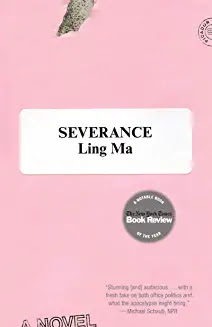
Ling Ma, Severance

A millennial novel, a New York City novel, an immigrant novel, a zombie novel, a pandemic novel… and a holiday novel? I would make the case that this is another hat that Severance gets to wear, even if the characters rarely mention the season. When a band of “Shen Fever” survivors, led by a murderous I.T. guy named Bob, hole up over the holidays in the suburban shopping mall of his childhood, they gather around pancakes, fried Spam, and Anthropologie place mats, pray to some version of a god, and celebrate the one-month anniversary of their self-imposed lockdown instead. Candace Chen, the novel’s protagonist and a perpetual wanderer, may be especially immune to the nostalgia that appears to trigger the virus, because unlike the other zombies, she doesn’t carry around Saturday-Evening-Post-esque memories of holiday homecomings and family gatherings—her lack the key to her survival.
Read about the other entries on the list.

--Marshal Zeringue

Monday, December 7, 2020

Nine great books set in very cold places

At Book Riot Laura Sackton tagged nine of her favorite wintery reads, including:
THE CITY IN THE MIDDLE OF THE NIGHT BY CHARLIE JANE ANDERS

There are plenty of cold places on earth, but there’s also a whole universe out there, and sci-fi and fantasy writers have been imagining frigid planets for years. This unique sci-fi story is set on a tide-locked planet; one side is blazing hot, the other a dark and frozen wilderness. The story follows Sophie, a young woman exiled into the darkness after a failed attempt at revolution, and Mouth, the only survivor of a group of mysteries nomads. Their paths intersect as they both navigate the challenges of life on a strange, and often brutal, planet.
Read about the other entries on the list.

--Marshal Zeringue

Sunday, December 6, 2020

Six mysteries that prove you can’t go home again

Tessa Wegert is the author of Death in the Family and The Dead Season, part of the Shana Merchant series of mysteries.

At CrimeReads, Wegert tagged six "crime fiction novels that rely on home as a major theme," including:
The Long Way Home by Louise Penny

The 10th book in Louise Penny’s Inspector Gamache series of mysteries finds Gamache, Jean-Guy Beauvoir, and villagers Clara Morrow and Myrna travelling away from their home in an effort to recover Clara’s “sin-sick” artist husband and return him safely to Three Pines. Eclipsed by his wife’s fame, which has driven a wedge between the couple, Peter Morrow flees to the wilds of Northern Quebec, but both Gamache and Clara fear his efforts to self-exile may have deadly results.

This is a book that dissects the notion of what “home” means to different people. For Peter Morrow, home isn’t just Three Pines. Rather, it’s his wife, whom he wishes to return to, and who wants nothing more than to right their life together.
Read about the other entries on the list.

--Marshal Zeringue

Saturday, December 5, 2020

Eight fictional housewives who have snapped (in a fun way)

Katie Yee is a Brooklyn-based writer and the Book Marks associate editor at Lit Hub. If you follow @bookmarksreads on Instagram, you'll see lots of photos of her rescue dog, Oliver.

At Lit Hub she tagged eight novels featuring women who have had enough. One title on the list:
The Ohio housewife of Lucy Ellmann’s Ducks, Newburyport

Ducks, Newburyport—the dark horse shortlisted for last year’s Booker Prize—is almost one thousand (1,000!) pages full of one woman’s stream of consciousness. I mean, it’s every fleeting thought that crosses her mind in an unstoppable torrent that’s basically one long, winding sentence. We see her concerns about the state of the country, her ongoing pangs of grief about her parents, her love for her husband, her to-do list for preparing dinner, her fears regarding her children. It’s a small joy to swing from thought to thought with her, to try to understand the leaps she makes. What’s more alarming: watching her police her own thoughts. It’s a fascinating social critique, the way she skitters away from certain subjects, even in her own mind. Does this sound confusing? Rest assured: Lucy Ellmann has a steady hand, masterfully guiding you through the rabbit hole without you even noticing. The genius here is in her ability to make us recall something from pages and pages ago; her phrasing is so precise that when she briefly references something, the reader knows immediately what she’s talking about. It makes you feel like you really are swimming in her subconscious, and really, what’s more maddening than being surrounded by someone’s inner-most thoughts that way?
Read about the other entries on the list.

--Marshal Zeringue

Friday, December 4, 2020

Five titles about the horror of winter

Evie Green is a pseudonym for a British author who has written professionally for her entire adult life. She lives by the sea in England with her husband, children, and guinea pigs, and loves writing in the very early morning, fueled by coffee.

Her new novel is We Hear Voices.

At Tor.com, Green tagged five favorite horror books set in snow, including:
Dark Matter by Michelle Paver

I don’t think snowy horror gets better than Michelle Paver’s masterful fictional account of a 1937 winter in Svalbard, deep in the Arctic. This book is written in the form of diary entries from Jack, who is at a low point in London when he is invited to join an expedition to Svalbard as radio operator. He joins in spite of his misgivings, and they set off north, eventually ignoring local advice and setting up camp at remote Gruhuken on the island of Spitsbergen. As the polar winter descends and four months of absolute darkness set in, various events compel Jack’s companions to abandon the mission, leaving him entirely alone . . . or is he? The real terror of being alone in the dark, cut off by snow and ice, and with a hostile presence lurking, left me breathless. This book is terrifying. I went to Svalbard on my honeymoon last year partly because of it.
Read about the other entries on the list.

--Marshal Zeringue

Five of the best open-ended novels

Caz Frear grew up in Coventry, England, and spent her teenage years dreaming of moving to London and writing a novel. After fulfilling her first dream, it wasn’t until she moved back to Coventry thirteen years later that the second finally came true. She has a degree in History & Politics, and when she’s not agonizing over snappy dialogue or incisive prose, she can be found shouting at Arsenal football matches or holding court in the pub on topics she knows nothing about. She is the author of three Cat Kinsella novels: Sweet Little Lies, Stone Cold Heart, and Shed No Tears.

[The Page 69 Test: Sweet Little Lies; The Page 69 Test: Stone Cold Heart.]

At CrimeReads, Frear tagged five of her favorite novels with ambiguous endings, including:
Black and Blue, Ian Rankin

Black and Blue, the eighth in Rankin’s Rebus series, is often considered his breakout novel. It is arguably his most ambitious too. This is a long and brilliantly complex read, with four separate plots spanning the length and breadth of Scotland—the main focus being the investigation into a copycat killer, Johnny Bible, which puts Rebus on the tail of the original Bible John (a real serial killer who terrorized Glasgow in the 1960s).

As Black and Blue forms part of a series, the open ending is probably a little less controversial. After all, police procedural fans expect—and love—to follow long-running threads and character arcs. However, the ending here isn’t just a cliff-hanger, designed to bring readers back for the next installment. It feels more meaningful than this. It’s a reminder that life isn’t always fair. Justice isn’t always served. And that stories don’t always need to be tied up with a nice neat bow.
Read about the other entries on the list.

Black and Blue is among Joseph Knox's four top novels for crime lovers. Euan Ferguson called it Rankin's finest book and put John Rebus on his list of the ten best fictional sleuths; it is one of the ten most popular Scottish novels of the last 50 years.

--Marshal Zeringue

Thursday, December 3, 2020

Ten top Shakespearean books

Robert McCrum was born and educated in Cambridge. For nearly 20 years he was editor-in-chief of the publishers Faber & Faber, and then literary editor of the Observer from 1996 to 2008. He is now an associate editor of the Observer. He is the author of Every Third Thought, My Year Off, Wodehouse: A Life (2004), six novels, and the co-author of the international bestseller, The Story of English (1986). His new book is Shakespearean: On Life & Language in Times of Disruption.

At the Guardian, McCrum tagged his top ten Shakespearean books, including:
A Thousand Acres by Jane Smiley

Many US novelists have been bitten by the Shakespeare bug: Toni Morrison (Desdemona), John Updike (Gertrude and Claudius) and Arthur Phillips (The Tragedy of Arthur) from contemporary fiction. More popular, perhaps, is Smiley’s modernisation of King Lear, in which Shakespeare’s plot and characters are relocated to the midwest. Smiley says that her novel grew out of her response to “the ways in which I found the conventional reading of Lear frustrating and wrong”. Part of Shakespeare’s eternal youth is that he always invites us to find new responses to his work.
Read about the other entries on the list.

A Thousand Acres is among Rachel Mans McKenny's eleven books about midwesterners who aren’t trying to be nice, Hannah Beckerman's top ten toxic families in fiction, Brian Boone's five books that offer a brand new take on pre-existing works, Edward Docx's top ten Shakespearean stories in modern fiction, Emma Donoghue's six best books, Anne Tyler's six favorite books, Sally O'Reilly ten top novels inspired by Shakespeare, Alexia Nader's nine favorite books about unhappy families, and John Mullan's top ten twice-told tales.

--Marshal Zeringue