Sunday, June 2, 2013

George Packer's six favorite books

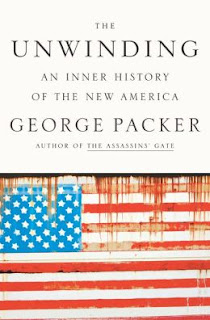
George Packer's new book is The Unwinding: An Inner History of the New America.

One of his six favorite books, as told to The Week magazine:
Bleak House by Charles Dickens

Dickens was sui generis, but I keep meeting his outsize, struggling characters in places like Yangon, Myanmar, and Lagos, Nigeria. Societies and literary styles have changed since the 1850s, but there's nothing dated about the moral vision.
Read about the other books on Packer's list.

Bleak House is one of Oliver Ford Davies's six best books, Ian Rankin's 5 favorite literary crime novels, Tim Pigott-Smith's six best books, James McCreet's top ten Victorian detective stories and one of Rebecca Ford's favorite five fiction books. It is on John Mortimer's list of the five best books about law and literature and John Mullan's lists of ten of the best thunderstorms in literature and ten of the best men writing as women, and is among the top ten works of literature according to Stephen King.

Writers Read: George Packer (July 2007).

--Marshal Zeringue

Saturday, June 1, 2013

Honeysuckle Weeks's six best books

Honeysuckle Weeks is best known for playing Samantha Stewart in eight series of ITV's Foyle's War.

One of her six favorite books, as told to the Daily Express:
JANE EYRE by Charlotte Brontë

I read this at school and felt sympathy with everything Jane thought. Rochester was a bit gloomy but very attractive. I identified with the poor governess-type who strives after the heart of a dark lord: then I married one myself.
Read about the other books on the list.

Jane Eyre also made Kathryn Harrison's list of six favorite books with parentless protagonists, Megan Abbott's top ten list of novels of teenage friendship, a list of Bettany Hughes's six best books, the Guardian's top 10 lists of "outsider books" and "romantic fiction;" it appears on Lorraine Kelly's six best books list, Esther Freud's top ten list of love stories, and Jessica Duchen's top ten list of literary Gypsies, and on John Mullan's lists of ten of the best governesses in literature, ten of the best men dressed as women, ten of the best weddings in literature, ten of the best locked rooms in literature, ten of the best pianos in literature, ten of the best breakfasts in literature, ten of the best smokes in fiction, and ten of the best cases of blindness in literature. It is one of Kate Kellaway's ten best love stories in fiction.

The Page 99 Test: Jane Eyre.

--Marshal Zeringue

Friday, May 31, 2013

Top ten utopias

The Wu Ming Foundation is a collective of novelists based in Italy. They are the authors of several novels. As of springtime 2013, four of them are available in English: Q, 54, Manituana and Altai.

One of ten top utopias they named for the Guardian:
Kirinyaga by Mike Resnick

On a terraformed planetoid called Kirinyaga (the Gikuyu name of Mount Kenya), a Gikuyu community tries to live as their ancestors did before Kenya was colonised. For Koriba, the self-appointed mundumugu (witch doctor) of the community, this is a dream come true. It goes without saying that things don't go as he expected, but after the predictable failure of the utopian programme, Kirinyaga becomes a much more intriguing book, a book on Koriba's return to a transfigured, futuristic Nairobi and the unrelenting utopian impulse which makes him a stranger in a strange city. He's got only two friends: an old man and a clone of Ahmed of Marsabit (the most famous elephant in the history of Kenya). When he achieves a creative synthesis between utopian impulse and death drive, he finds a way out.
Read about the other utopias on the list.

--Marshal Zeringue

Thursday, May 30, 2013

Three books that concern food but aren't in love with food

Jessica Soffer earned her MFA at Hunter College. Her work has appeared in Granta, the New York Times, and Vogue, among other publications. She teaches fiction at Connecticut College and lives in New York City.

Soffer's new novel, her debut, is Tomorrow There Will Be Apricots.

For NPR she tagged three books that concern food but aren't in love with food, including:
The Particular Sadness of Lemon Cake by Aimee Bender

Rose Edelstein has a very strange superpower: She can taste emotion. In her mother's lemon cake: sadness. In her father's pudding: distraction. In butter, she can taste the weariness of a dairy farmer in Wisconsin. In this way, she discovers the secret emotions of the world, but more immediately, more heartbreakingly, the deepest, darkest wells of pain of her family members. In order to just sustain herself — and not feel too much — poor Rose must resort to consuming factory-produced foods: the most absent, anonymous, nonthreatening things she can find. Eating, in this wonderful novel, is not an exercise in joy, or intimacy, or beauty — or even a means toward nourishment. It is nothing so benign.
Read about the other books on the list.

The Particular Sadness of Lemon Cake was one of Janice Kaplan's twelve best fiction titles of the summer, 2010.

Visit Jessica Soffer's website and learn about ten of her favorite endings in books.

Writers Read: Jessica Soffer.

My Book, The Movie: Tomorrow There Will Be Apricots.

--Marshal Zeringue

Five top books on golf

One title on the Barnes & Noble Review's list of five top books on golf:
The Heart of a Goof by P. G. Wodehouse

Golf is known as the gentleman's game, and who better to write about it than the eminent gentleman himself? In The Heart of a Goof, Wodehouse delivers nine short stories set on the fairway with his signature acerbic wit -- profiling golf-obsessed buffoons and the ladies who tolerate them.
Read about the other books on the list.

Another Wodehouse book, The Clicking of Cuthbert, is among Rick Gekoski's five favorite books on sports.

--Marshal Zeringue

Wednesday, May 29, 2013

Three of the best books on Nigeria

At the Guardian, Pushpinder Khaneka named three of the best books on Nigeria. One title on the list:
Things Fall Apart, by Chinua Achebe

Achebe is regarded as the father (perhaps now grandfather) of modern African literature. His first novel – written as a riposte to Joseph Conrad's Heart of Darkness and what Achebe saw as its distortions – has become a classic, and is one of the most widely read African novels. It tells the tragic story of Okonkwo, a powerful and ambitious warrior among Nigeria's Igbo people. Set during the scramble for Africa by the European powers in the 1890s, it portrays the devastating impact of English Christian missionaries and colonial laws on Igbo culture.

Achebe is a sympathetic voice, but he refuses to romanticise precolonial life and pulls no punches in revealing the flaws of his characters. Okonkwo is forced into a seven-year exile for accidentally killing a member of his clan. When he returns, he finds that traditional life is being corroded by the encroaching colonisers. When he and others, unwilling to adapt, try to combat this outside influence, things fall apart.

Through the novel, for the first time, outsiders were able to see Africans as they saw themselves.

Until his death on 21 March, Achebe was a thorn in the side of Nigerian military governments – and that often meant going into exile.
Read about the other books on the list.

Things Fall Apart is among Hallie Ephron's ten best books for a good cry, Helon Habila's three books to help understand Nigeria, and Martin Meredith's ten books to read on Africa.

--Marshal Zeringue

Top ten books on Burma

Rory MacLean's books include Under the Dragon: A Journey Through Burma. He has won the Yorkshire Post Best First Work prize and an Arts Council Writers' Award, was twice shortlisted for the Thomas Cook/Daily Telegraph Travel Book Prize and was nominated for the International IMPAC Dublin Literary award. He is a Fellow of the Royal Society of Literature and a regular contributor to BBC Radio 3 and 4.

One of his top ten books on Burma, as told to the Guardian:
Freedom from Fear and Other Writings by Aung San Suu Kyi

Few women in public life have suffered more for their beliefs than Aung San Suu Kyi, and inspired so many people by their example. "Concepts such as truth, justice, compassion are often the only bulwarks which stand against ruthless power," she once wrote. Like the country itself, she too is working through a "democratic transition", from prisoner to parliamentarian, to (probably) president in 2015. In this collection of writings, which includes her Nobel peace prize speech, she shares the vision, hopes, principles and humanity that have sustained and continue to sustain her.
Read about the other entries on the list.

Note: In 1989, the military government officially changed the English translations of many names dating back to Burma's colonial period, including that of the country itself: "Burma" became "Myanmar." The renaming remains a contested issue.

--Marshal Zeringue

Tuesday, May 28, 2013

Thirteen post-apocalyptic stories that actually teach valuable lessons

At io9, Amanda Yesilbas, Katharine Trendacosta, and Annalee Newitz came up with thirteen post-apocalyptic stories that actually teach valuable lessons, including:
Always Coming Home, by Ursula Le Guin

Le Guin's novel is a direct retort to [Isaac Asimov's] Foundation. Instead of preserving the old civilization in vast storehouses, this book advocates throwing out the old civilization and starting over fresh with new ideas that won’t lead to a repeat of past mistakes. This book’s particular new civilization on a an idyllic, primitive matriarchy. Perhaps a little to Utopian for reality, but it does make a case for not repeating history.
Read about the other stories on the list.

--Marshal Zeringue

Monday, May 27, 2013

Omid Djalili's six best books

Omid Djalili is a British Iranian stand-up comedian and actor. He appeared in Gladiator as a slave trader and was Cairo prison warden Gad Hassan in The Mummy.

One of his six best books, as told to the Daily Express:
Captain Corelli's Mandolin by Louis de Bernieres

I read this on a film set and got so into the book that the filming became a bit of an annoyance.

By the end I was in floods of tears and couldn't come out of my trailer. I'm very moved by old love and the fact people hold on to love for years.
Read about the other books on the list.

Captain Corelli's Mandolin is one of Olivia Williams's six best books.

--Marshal Zeringue

Sunday, May 26, 2013

Three classic books on Colombia

At the Guardian, Pushpinder Khaneka named three of the best books on Colombia. One title on the list:
Delirium, by Laura Restrepo

Restrepo sets her novel in the drug-fuelled 1980s heyday of cocaine king Pablo Escobar, and uses insanity in one family to reflect the collective insanity of her native Colombia. Aguilar, a grizzled, leftwing literature professor who is reduced to selling dog food to make ends meet, returns from a business trip to find that his beautiful wife, Agustina, has gone mad. In his search for the causes of her delirium, he uncovers secrets and lies from her troubled past.

This complex and captivating novel uses the voices of Agustina, her husband, her father and a former lover – Midas McAlister, a flamboyant money-launderer and drug trafficker – to give an account of a Colombia in thrall to narco-capitalism and battered by violence and corruption. The story mostly takes place in the capital, Bogotá, which Aguilar describes as a city "where everyone's at war with everyone else".

Restrepo has a sharp eye for exposing the hypocrisies and class divisions that dog Colombian society, and memorably depicts the period's excesses. Yet, through this morass, the novel remarkably ends on a note that is, if not quite happy, at least hopeful.
Read about the other books on the list.

Also see: Top ten Colombian stories.

--Marshal Zeringue

Five top books by and about obsessed artists

Patricia Volk is the author of the memoir Stuffed; the novels To My Dearest Friends and White Light; and two collections of short stories, All it Takes and The Yellow Banana.

Her new book is the memoir, Shocked: My Mother, Schiaparelli, and Me.

One of Volk's five favorite books by and about obsessed artists, as told to the Wall Street Journal:
Diary of a Genius
by Salvador Dalí (1965)

My grandmother would have thought he was out of his mind, but she would have loved Dalí's enthusiastic descriptions of his excreta. Dalí obsesses over his beloved rhinoceros horn, too, and his flatulence, flies (he is partial to the local gray-bellied variety) and Gala, whom he loves so much he marries three times. One year he makes over a hundred things. Paintings, of course. But there were movies, plays, books, scripts, sculptures and performance art before it had a name. In "Diary of a Genius" we observe the man at work in his beloved Port Lligat on the westernmost tip of Spain. There he is, painting naked, unaware of time, making you see what he sees. He makes you feel his paint creaming on. Here is Dalí at his serious-cum-antic best. Discovering the "Diary" when I was in college studying to be a painter hooked my dream life to my waking life. For full-bore pleasure, find copies of "The Assumption" (1952) and "Corpus Hypercubicus" (1954) to glance at while he describes painting them.
Read about the other books on the list.

--Marshal Zeringue

Saturday, May 25, 2013

Five top books on the life and times of U.S. soldiers

One title on the Barnes & Noble Review's list of five top books on the life and times of U.S. soldiers:
Gettysburg: The Last Invasion
by Allen C. Guelzo

If Beevor's expertise [in D-Day: The Battle for Normandy] is in depicting a soldier's character, Allen C. Guelzo shines when conveying the sensory experience of a soldier going into battle, particularly within a conflict as uniquely devastating as the American Civil War. Consider Guelzo's depiction of troops so unwashed -- giving new meaning to the term "rank" -- that the enemy could actually smell them coming. Guelzo's depictions of the lay of the land - and clouds of gunpowder clouds overhead - set a vivid stage for the Battle of Gettysburg's devastating duel between two halves of a nation divided.
Read about the other books on the list.

Learn more about Gettysburg: The Last Invasion.

Also see: Five best books about war by authors who served.

--Marshal Zeringue