Thursday, June 13, 2013

Top ten father memoirs

Andre Gerard is the founder of Patremoir Press and the editor of Fathers: a Literary Anthology.

One of his top ten father memoirs, as told to the Guardian:
Father and Son by Edmund Gosse

The first of all father memoirs, this is still one of the best. Interestingly, Gosse's first attempt to write about his father took the form of an official biography. Written shortly after his father's death on 23 August 1888, The Life of Philip Henry Gosse was admired by Henry James as "a singularly clever, skilful, vivid, well-done biography of his father, the fanatic and naturalist – very happy in proportion, tact and talent". Luckily, at least two other readers – John Addington Symonds and George Moore – suggested that Gosse should be more autobiographical and explore the father-son relationship.

Almost 20 years later, Gosse unburdened himself of Father and Son. Though the book was an immediate success and the reviews were largely enthusiastic, the reviewer of the Academy had reservations about the "close anatomisation by a son of a father", and the Times Literary Supplement raised the question of "how far in the interests of popular edification or amusement it is legitimate to expose the weaknesses and inconsistencies of a good man who is also one's father". Perhaps not always fortunately, subsequent writers, far more frank and confessional, showed far fewer qualms in writing about their fathers.
Read about the other books on the list.

Father and Son is one of Alexander Waugh's five best books that capture the complexities of father-son relationships. Susan Cheever called it a "model for writing about a parent."

--Marshal Zeringue

Wednesday, June 12, 2013

Ten must-read historical thrillers

Matt Rees is an award-winning crime novelist. His series about Palestinian sleuth Omar Yussef won a CWA Dagger. His latest novels are Mozart's Last Aria, a historical thriller about the composer's death, and A Name in Blood, a portrayal of Italian artist Caravaggio and his mysterious disappearance.

One title on Rees's list of ten must-read historical thrillers:
The Silence. J. Sydney Jones

In this marvelous novel the real mayor of Vienna at the onset of the twentieth century, Karl Lueger, is at the heart of a conspiracy to raise big money from the sale of the Vienna Woods and at the same time to gain political capital by blaming Jewish property developers for the destruction of the city’s beloved green belt. It’s a measure of Jones’s skill as a writer that, while his hero is a lawyer-turned-investigator of Jewish origin, the novel’s Jews are not really better or worse than the society around them. They aren’t portrayed as poor saintly victims. They’re simply part of Jones’s Vienna, as they were part of historical Vienna. There’s also a youthful role for little Ludwig Wittgenstein. For lovers of Sherlock Holmes, you can’t go wrong with Jones.
Read about the other books on the list.

The Page 69 Test: The Silence.

Visit Matt Beynon Rees' website.

My Book, The Movie: Mozart's Last Aria.

The Page 69 Test: Mozart's Last Aria.

Writers Read: Matt Rees (December 2011).

--Marshal Zeringue

Tuesday, June 11, 2013

Mohsin Hamid's six favorite books

Mohsin Hamid is the author of the novels Moth Smoke, The Reluctant Fundamentalist, and How to Get Filthy Rich in Rising Asia. His fiction has been translated into over 30 languages, shortlisted for the Man Booker Prize, featured on bestseller lists, and adapted for the cinema. His short stories have appeared in The New Yorker, Granta, and the Paris Review, and his essays in the Guardian, the New York Times, and the New York Review of Books. Born in 1971, he has lived about half his life, on and off, in Lahore. He also spent part of his early childhood in California, attended Princeton and Harvard, and worked for a decade as a management consultant in New York and London, mostly part-time.

One of his six favorite books, as told to The Week magazine:
Dune by Frank Herbert

This 1965 space saga set on a desert planet is a racy read and one of the best-selling sci-fi novels of all time. But for me it was the Middle Eastern, indeed quasi-Muslim, inspirations that Herbert layered into his book that introduced me to the idea of literary hybridity. It's sadly hard to imagine, post-9/11, this novel being written today.
Read about the other books on Hamid's list.

Dune is among io9's ten science fiction novels you pretend to have read, and on John Mullan's lists of ten of the best vendettas in literature and ten of the best deserts in literature, and among the best and worst childbirth scenes in sci-fi & fantasy.

Visit Mohsin Hamid's website and Facebook page.

Mohsin Hamid's most influential book.

Mohsin Hamid's 10 favorite books.

The Page 69 Test: The Reluctant Fundamentalist.

Writers Read: Mohsin Hamid.

--Marshal Zeringue

Monday, June 10, 2013

Ten sources that inspired "Game of Thrones"' dark storytelling

At io9 Katharine Trendacosta and Charlie Jane Anders came up with a list of ten sources that inspired Game of Thrones' dark storytelling, including:
J.R.R. Tolkien's Lord of the Rings

You probably won't be surprised to hear that Martin borrowed a lot from Tolkien for his epic fantasy series. Both the idea of a "secondary world," in which certain things (like the seasons) are very different, but also the initial structure. Tolkien was "my great model" for the handling of the characters in Song of Ice and Fire, Martin has said. Lord of the Rings "begins with a tight focus, and all the characters are together. Then by end of the first book the Fellowship splits up, and they have different adventures." Apart from Daenerys, all of Martin's characters are together in his first book, and they all split into groups, which eventually split up as well. Adds Martin: "The intent was to fan out, then curve and come back together. Finding the point where that turn begins has been one of the issues I’ve wrestled with." Another major influence from Tolkien: the restrained use of magic. You don't see Gandalf casting a lot of spells or throwing fireballs in the Lord of the Rings saga. When there's danger, Gandalf mostly pulls out his sword.
Read about the other entries on the list.

The Lord of the Rings also made Rob Bricken's list of 11 preposterously manly fantasy series, Conrad Mason's top ten list of magical objects in fiction, Linus Roache's six best books list, Derek Landy's top ten list of villains in children's books, Charlie Jane Anders and Michael Ann Dobbs' list of ten classic SF books that were originally considered failures, Lev Grossman's list of the six greatest fantasy books of all time, and appears on John Mullan's lists of ten of the best women dressed as men, ten of the best bows and arrows in literature, ten of the best beards in literature, ten of the best towers in literature, ten of the best volcanoes in literature, ten of the best chases in literature, and ten of the best monsters in literature. It is one of Salman Rushdie's five best fantasy novels for all ages. It is a book that made a difference to Pat Conroy.

--Marshal Zeringue

Sunday, June 9, 2013

Five top books on privacy

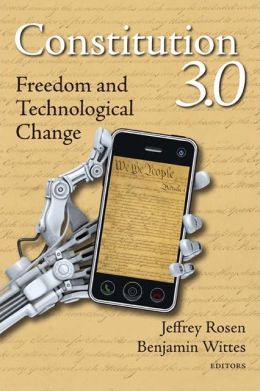
Jeffrey Rosen is the president and chief executive of the National Constitution Center in Philadelphia and a law professor at George Washington University. He is legal affairs editor of The New Republic, and co-editor (with Benjamin Wittes) of Constitution 3.0: Freedom and Technological Change.

Prefacing his Washington Post list of five favorite books on privacy, Rosen recommends first reading "the best article on privacy ever written: Samuel Warren and Louis Brandeis’s 'The Right to Privacy,' first published in the Harvard Law Review in 1890 and available online."

One of Rosen's top books on the right to privacy:
THE FUTURE OF THE INTERNET AND HOW TO STOP IT by Jonathan Zittrain (2008).

In addition to illuminating how the Internet works, Zittrain explores the transition from what he calls Privacy 1.0, where threats to privacy came mostly from data stored in government and corporate databases, to Privacy 2.0, where the data is generated, recorded and shared by individuals. Zittrain helps illuminate why the government and the private sector can share information so easily, and why the law seems to make that easier, not harder.
Read about the other books on Rosen's list at the Washington Post.

Learn about a couple of Rosen's favorite books on the Supreme Court, and follow him on Twitter.

--Marshal Zeringue

Five top books on heat waves and hot places

Biologist Bill Streever wrote the national bestseller, Cold, and the follow up, Heat. He lives with his son, Ish Streever, his partner and wife, marine biologist Lisanne Aerts, and the resident dog, Lucky (who was adopted from Sakhalin, Russia) in Anchorage, Alaska. The four of them ski, hike, dive, bike, and camp as often as time and their varying abilities allow.

One of five top books on heat waves and hot places that Streever named for the Wall Street Journal:
The Devil's Highway
by Luis Alberto Urrea (2004)

'In the desert,' writes Luis Alberto Urrea, "we are all illegal aliens." The desert he describes is the Sonoran, in southern Arizona, and the real-life story he tells, set in 2001, is of a group of people desperate enough for jobs to cross the desert on foot and without immigration papers. Walking at night to avoid the sun, they went west and south when they should have gone north. They ran out of water. Fourteen of them perished. From a survivor: "I do not know who was dying or how many because I too was dying." Of the 26 men who began the journey, only 12 lived. Interviews with survivors and others, captured in Urrea's brilliant writing, mix accounts of the heat's toll with observations on politics and human decency. Urrea's chronicle shimmers like an image seen through the heat haze of a desert afternoon, becoming clearer and more tragic with the passing of every word.
Read about the other books on Streever's list.

Learn about Streever's five best books about extreme cold.

Visit Bill Streever's website.

The Page 99 Test: Cold.

Writers Read: Bill Streever (February 2013).

--Marshal Zeringue

Saturday, June 8, 2013

Five top books about the body

Gabriel Weston is an English surgeon and author. Her memoir entitled Direct Red: A Surgeon's Story was published in February 2009. It was long-listed for the Guardian First Book Award in September 2009 and won the PEN/J Ackerley Award for Autobiography in May 2010. Her new novel is Dirty Work.

One of five books about the body that Weston tagged for the Telegraph:
The Man who Mistook his Wife for a Hat (1985) by Oliver Sacks crystallised my desire to become a doctor, not only for its meaty medical subject matter but also the poetic glow of the writing. Sacks showed me that there is space for the imagination in medicine.
Read about the other books Weston named.

The Man who Mistook his Wife for a Hat is one of Lisa Genova's six favorite books about science & literature.

--Marshal Zeringue

Friday, June 7, 2013

Top ten unusual fictional families

Matt Whyman is a bestselling author, also known for his work as an advice columnist for numerous teenage magazines.

He has written two novels for adults, Man or Mouse and Columbia Road, as well as both fiction and non-fiction for teenagers, including Superhuman, XY, Boy Kills Man, XY:100, The Wild, the So Below trilogy, Inside the Cage and Goldstrike. His latest novel is The Savages.

One entry on Whyman's top ten list of unusual fictional families, as told to the Guardian:
The Radleys by Matt Haig

Rowan and Clara seem to be typical teenagers living an everyday existence under the guidance of their conservative parents. Things take a turn for the strange when the pair discover that there's a reason why they burn easily in sunlight, dislike garlic and scare birds out of trees. But can vampires really abstain, as Mr and Mrs Radley strive to believe, or will their bloodlust prove impossible to repress?
Read about the other families on the list.

The Page 69 Test: The Radleys.

My Book, The Movie: The Radleys.

--Marshal Zeringue

Thursday, June 6, 2013

Five top portraits of grief

Joshua Henkin is the author of the novels Matrimony, a New York Times Notable Book, and Swimming Across the Hudson, a Los Angeles Times Notable Book and The World Without You, winner of the 2012 Edward Lewis Wallant Award for Jewish American Fiction and a Finalist for the 2012 National Jewish Book Award.

One of his five best portraits of grief, as told to the Wall Street Journal:
Half a Life
by Darin Strauss (2010)

'Half my life ago, I killed a girl." So begins Darin Strauss's brutally unsentimental memoir of when he was 18 and Celine Zilke, a girl from his Long Island high school, swerved her bicycle in front of his car in what may have been a suicide. Told in bursts of chapters, some only a paragraph long, the book is an exquisitely wrought examination of Strauss's feelings of guilt (he was cleared of all wrongdoing) and of the guilt he feels for feeling guilty in the first place. Should he visit Celine in the hospital? Should he go to her funeral? How, Strauss wonders, can he even ask such questions? If he thinks of the accident as being about him, he will diminish what happened to Celine and her family. Yet everywhere he goes, he is made to feel that the accident is about him: in school assemblies, on dates, even by Celine's mother, who tells him: "Whatever you do in your life you have to do it twice as well now. Because you are living it for two people." "Half a Life" is about Strauss's failure to do this—about the very impossibility of the enterprise.
Read about the other entries on the list.

The Page 99 Test: Darin Strauss' Half a Life.

--Marshal Zeringue

Wednesday, June 5, 2013

Five of the best children's book protagonists

Clara Vulliamy is the author and illustrator of numerous series for children, including the Martha and the Bunny Brothers series, Muffin series, Lucky Wish Mouse series, and The Bear with the Sticky Paws series. She lives in London, England.

One of Vulliamy's five best children's book protagonists, as told to the Telegraph:
Piglet, from ‘The House at Pooh Corner’
by AA Milne

Piglet is brave, honourable and trusting, but beset by constant anxieties. With his ears trembling with nerves and his lovely round belly in an all-in-one stripy green vest, he is a sublime example of appearance and personality working together as one. His conversations with devoted pal Pooh are the soundtrack of my childhood.
Read about the other entries on the list.

AA Milne and EH Shepard made Chris Riddell's top ten list of author/illustrator double acts. When We Were Very Young by A. A. Milne is on Glen Roven's list of seven poetry books to ignite your imagination. Milne's The House at Pooh Corner is a book to which Jonathan Kozol will always return; and Winnie-the-Pooh is one of the Barnes & Noble Review's top five books featuring toys and a book Walter Mosley hopes parents would read to their children.

--Marshal Zeringue

Tuesday, June 4, 2013

Ten of the biggest book adaptation flops

One of the ten biggest book-to-film flops--adaptations that were a critical/audience failure and a box office failure--Gabe Habash named for PWxyz, the news blog of Publishers Weekly:
All the King’s Men (2006)

Net Losses (inflation adjusted to 2012): $52,511,544

Rotten Tomatoes Score: 11%

Representative Review Quote: “Failures on the scale of writer-director Steven Zaillian’s All the King’s Men are as rare as falling sequoias, and they make a noise even if no one’s in the woods to hear them.” -New York Daily News

In 1949, Robert Penn Warren’s classic was adapted for the screen and won Best Picture, Best Actor (Broderick Crawford) and Best Supporting Actress (Mercedes McCambridge). In 2006, the book was adapted again, this time with Sean Penn screaming over inspirational music for two hours. No awards were won and the movie was called “depressing,” “dull” and “hysterically over-the-top yet strangely lifeless.”
Read about the other flops on the list.

All the King's Men appears on David Blight's list of five outstanding novels about the Civil War era, Heather Brooke's top five list of books on holding power to account, Melanie Kirkpatrick's list of her five favorite novels of political intrigue, and H.W. Brands's five best list of books on scandals...in truth or just in print; Robert McCrum called it a book to inspire busy public figures.

Also see: Fifteen top film adaptations of literary classics; Five great books that worked as films; and The Daily Telegraph's top 25 book to film adaptations.

--Marshal Zeringue

Monday, June 3, 2013

Fareed Zakaria's six favorite books

Fareed Zakaria is host of CNN’s flagship international affairs program—Fareed Zakaria GPS, editor at large of TIME, a Washington Post columnist, and a New York Times bestselling author. He was described in 1999 by Esquire magazine as “the most influential foreign policy adviser of his generation.” In 2010, Foreign Policy named him one of the top 100 global thinkers. Since 2008, he has hosted Fareed Zakaria GPS, which airs Sundays worldwide on CNN.

Zakaria’s most recent book, The Post-American World: Release 2.0, was heralded in the New York Times book review as “…a relentlessly intelligent book” and The Economist called it “…a powerful guide” to facing global challenges.

One of Zakaria's six favorite books, as told to The Week magazine:
Thinking, Fast and Slow by Daniel Kahneman

Most "idea books" are bloated essays; this one, from a Nobel Prize–winning economist, is worth reading all the way through. Kahneman offers a fascinating set of ideas about how human beings think and reason, for better and worse.
Read about the other books on the list.

Thinking, Fast and Slow is among Penn Jillette's 6 favorite books and Dylan Ratigan's six favorite books.

--Marshal Zeringue